





Inspiring Graduate: Evan Mancl (’25)
- Hometown: Chippewa Falls
- Degree: B.S. Applied Social Science
- Concentrations: History & Politics, Sociology & Anthropology
Evan Mancl has always been interested in sociology. The prospect of a related degree brought him to UW-Stout.
“The applied social science program felt like the best way to learn more about sociology,” said Mancl, who is a special education paraprofessional with Edustaff in Eau Claire.
“If I can be a teacher who students can feel seen around, someone that encourages the introverted to speak on what motivates them, someone who can destigmatize politics as partisan sports teams, someone who can make learning history enjoyable and can foster critical thinking regarding one’s surroundings, then I would consider that impact enough for me,” he said.
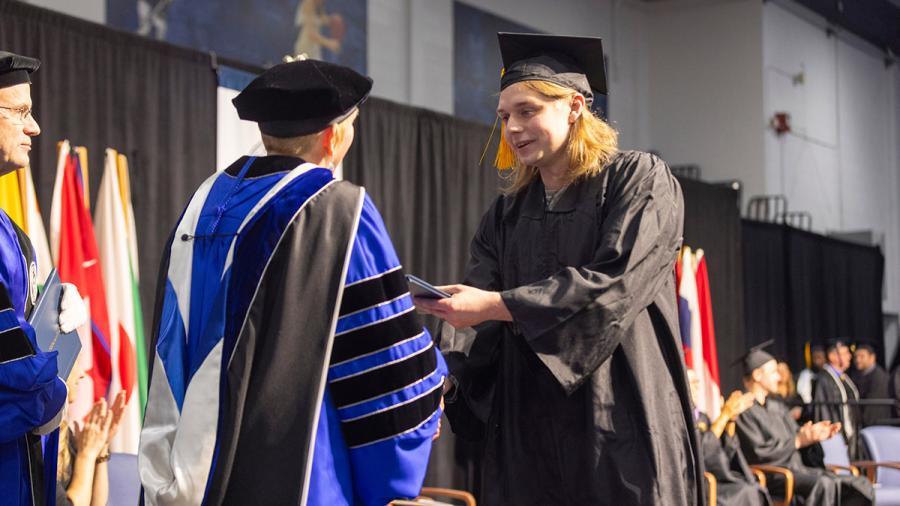
Mancl earned his applied social science degree and crossed the commencement stage on Dec. 20 as one of 527 UW-Stout graduates. He plans to begin substitute teaching full-time.
“I would love to teach social studies in high school within the Eau Claire area, where my wife and I are comfortable putting down roots. Although I’m not currently seeking a degree in education, the substitute position would open doors to other educators, teachers and principals who could help me learn curriculum building and classroom etiquette.
“This way I can begin my real dream of teaching full time, as an expert within the field of social sciences and in a way that makes teens about to enter the adult phase of their lives more aware of their environments: getting them civic-minded, culturally respectful and open to understanding their communities so that they may be more prepared to help the world,” he said.
How has UW-Stout prepared you to work in your field?
APSS is, I would say, more interesting than other majors in the Stout polytechnic model. Sociology, political science, anthropology and history are all subjects that people tend to hold within high academia. But truly, these are people who are on the ground constantly, studying the built environment of society. Their findings contribute to important government programs, important understandings of the myriads of cultures that span all around the state and raise awareness of social problems that many people talk about, but with very little ideas of solutions.
UW-Stout has an emphasis on graduation to career, and APSS does that by teaching us what groups we can join with our academic knowledge. How does the DNR create environmental policies around rural areas? What does city planning actually look like to communities who live in historic strife and oppression? In what ways are minority groups, who encompass a great deal of the state’s demographic, feeling separated from a government that is supposed to provide the basic necessities of life? How are people, regardless of class, impacted by the decisions made and how can they best be supported?
With the guidance of my capstone professors Tina Lee and Courtney Juelich, I’m surrounded by my colleagues within the program who are looking at positions within government and advocacy groups that are actively changing and influencing our social and physical environments. I’ve no doubt that I’ll be a great teacher, because I can convey all of these “big thoughts” in ways that compel people to seek out their solutions within their surroundings.
First student-designed mural is ‘part of the legacy, history of art at the university’
Continue ReadingWhat stands out about your UW-Stout experience?
The capstone is just a wonderful class. It directly trains you on everything you learn in the APSS program. I helped my classmates with Qualtrics surveys, physically explored the cultural roots in the Chippewa Valley I grew up in, and got constant feedback for a research paper that I’m very proud of authoring.
Truly, it gave me a sense of “I’ve always been able to do this, and so can everyone I meet.” The knowledge comes second to the passion of wanting things to be done. But it’s because of Tina and Courtney that I know how to put that passion into action.
My capstone, “The Social Construction of Cemeteries in the Chippewa Valley,” is really the culmination of my entire duration here. Every mistake I’ve made on papers before, every assignment I missed the deadline for, and the unbridled force of my sheer determination was a foundation for this project.
My research was based on interviews, fieldwork and a growing robust literature review that seeks to analyze the patterns of grief that people share with cemeteries. They’re an interesting space in public perception: serving a clear purpose and goal, yet largely different from how grief trends even in the last 20 years have shaped the way we sculpt physical memorials in our environment. I really wanted to write this paper also as a means of bringing death back to a point of public discussion. It’s a taboo topic, but it’s also kind of one of the core human experiences.
How did your involvement in campus impact your experience?
Living off campus in a city away and commuting, I personally feel has kept me away from trying out the many clubs and opportunities the campus offers. If I could do anything over, I would want to be involved more in the school itself because there’s just so many ways to get involved.
It’s my biggest regret, but hopefully someone can take this in mind and say, “Sure, I’ll go check out the free movie that’s put on every week or so.” Or “Yeah, being a part of representing students’ needs on campus does sound very helpful and cool.” It’s worth doing it now.
What challenges did you face in earning your degree and how did you overcome them?
During a couple of semesters, I was really becoming mentally fatigued and taxed by overworking myself in my job and school. I was able to see a counselor, who was able to help me get in touch with a psychiatrist in Eau Claire. I was officially diagnosed with ADHD and autism and was prescribed medication. The counselor helped me with managing strategies and behavioral techniques.
Being able to have that space and time to learn more about myself, along with the wonderful patience of the APSS faculty, I think is what got me through college. I wouldn’t be here if I didn’t feel the support I have, which makes me incredibly luckier than many others.
The Stout counseling department is amazing, and you can feel the passion of APSS professors. If you have questions, you will get answers and help with whatever you need because they want you to be the best you can be. It’s effort that gets applied both ways.
Any words of advice?
Whatever career you want to have, whatever subject you want to learn about, remember this; it affects where you live and how you live. Not just you, but your neighbors and their neighbors. At no point truly are we isolated from cause and effect. So, find where you are in that, and remember it. And if you want to know more about that vague word of advice, I know a really great college program that teaches you everything you need to know about it.