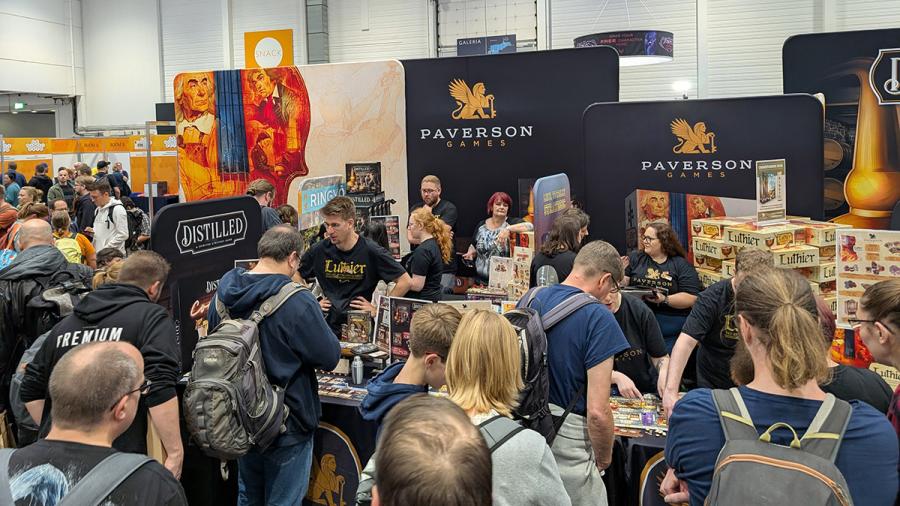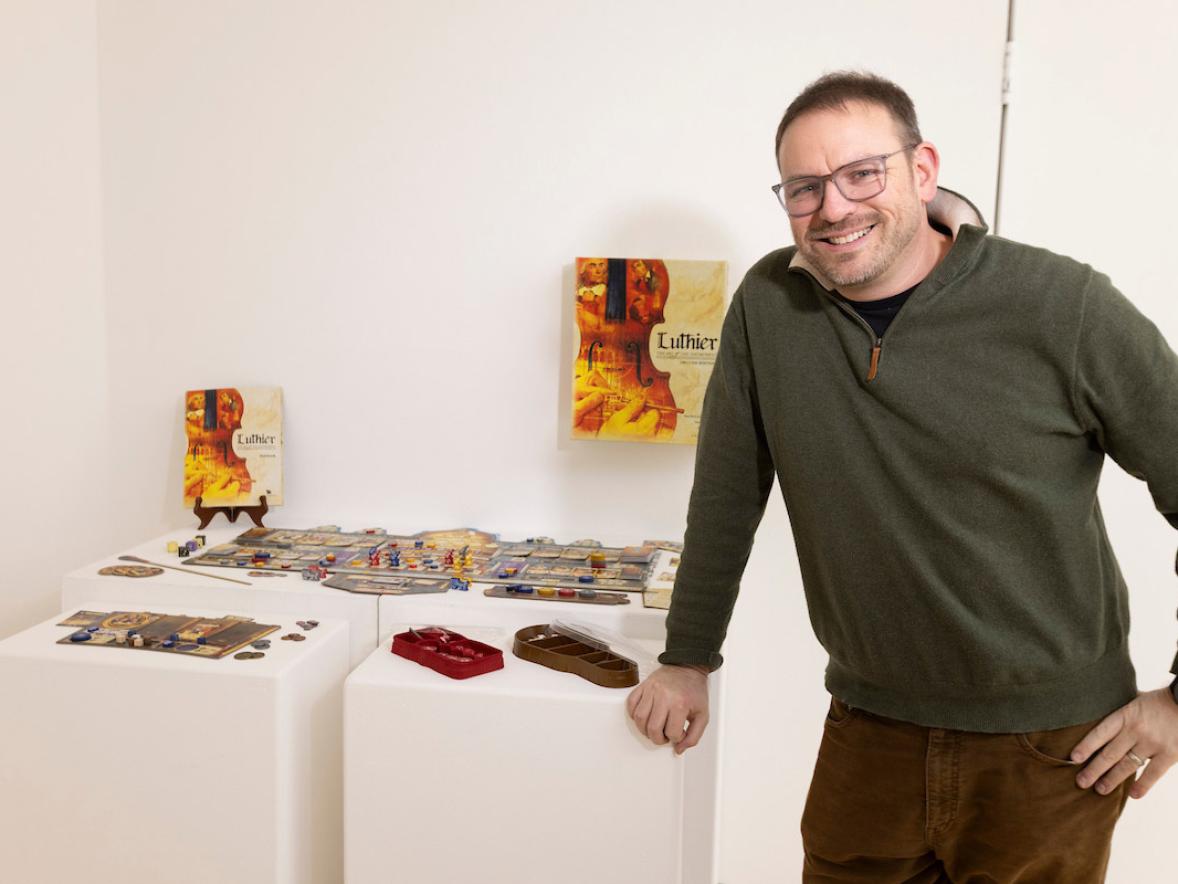






The gift of a board game, a visit to a historic distillery and a sleepless night during a sabbatical in Scotland combined to inspire UW-Stout Professor Dave Beck to create a successful game design business.
These experiences also transformed Beck’s approach to teaching students in UW-Stout’s game design and development programs. Whether they come from the artistic or computer science sides of game design, students make their way to Beck’s Introduction to Game Design course, where he stresses the fundamentals. And good design, he emphasizes, doesn’t have to start on a computer.
“It’s really the concept of the design and creating a system and a series of problems and challenges for a player to overcome,” Beck said. “That can happen on paper, or it can happen in pixels.”
The first assignment happens on paper, a common first step for budding game designers, as Beck’s students use cards, dice and other components to fashion paper prototypes. Paverson Games, Beck’s acclaimed indie game design business, also started in analog fashion.

Back in 2014, Beck — who has academic expertise in 3D modeling, virtual reality, animation, level design and game engines — was given a board game by his wife, UW-Stout Senior Lecturer Emily Beck, as a gift. Initially skeptical, he was quickly enchanted by Dominion, a medieval-themed deck-building game, which was very different from the frustrating, luck-based board games he remembered from childhood. Soon, he said, “I fell deep into a rabbit hole” and acquired a basement full of similar board games.
Beck isn’t alone in having his imagination captured by the hobby: Tabletop gaming has undergone a renaissance over the past decade or so, expanding into a $27 billion industry worldwide with projected annual growth of more than 10%. The trend has been driven by the increased availability of well-designed, attractive games like those produced by Paverson Games.
Yet for Beck, board games remained a pastime rather than a vocation for several years until he found himself on sabbatical in Scotland with his wife, who was teaching there for a semester. Amid working on his own 3D augmented reality project, Beck found time to play board games and tour some of Scotland’s legendary distilleries.
It was shortly after one such tour that Beck spent a sleepless night pondering a potential game. “Probably around midnight, this idea, truly a lightbulb moment, popped in my head about how I could represent the distilling process through a game mechanic, which is basically shuffling and removing cards to represent cutting out the heads and the tails,” he said. (In this context, “heads” and “tails” are byproducts from the beginning and end of the distillation process.)
The next morning found Beck scribbling notes and fashioning pieces of paper — much like his Introduction to Game Design students do. “The second I came up with this idea, I was cutting things out,” he recalled. “It was just like this energy inside me and this kind of joy — I don’t know how to better describe it — that I hadn’t felt in years.”
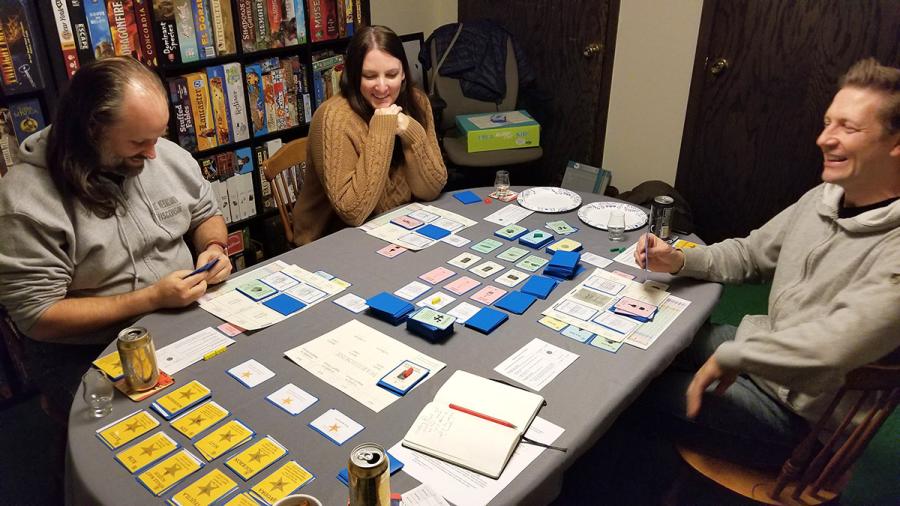
After more designing and play testing, Beck returned to Wisconsin with the basis of Distilled, which is marketed as a “spirited strategy game” in which players compete to become master distillers by creating whiskey, gin, rum and other spirits. He launched a Kickstarter in 2021, which raised its original goal of $18,000 in just 23 minutes. Ultimately, more than 8,000 backers pledged nearly $550,000 toward the project.
To make the game a reality, Beck leaned on the talents of some of his UW-Stout colleagues. Professor Erik Evensen, program director for the B.F.A. illustration program, created the artwork and served as graphic designer for the project. Professor Seth Berrier, program director in B.S. computer science (game design and development concentration), helped create an online version of Distilled, which allowed users to play test the game and give feedback. Meanwhile, Associate Professor Cody Reimer, program director for B.S. game and media studies, used his technical writing skills to edit the rulebook and game text.
More than four years after the original Kickstarter launched, Distilled has sold more than 50,000 copies across 10 different languages. (A cocktail-themed expansion launched last fall raised an additional $631,000 on Kickstarter.) And Beck’s business has gained attention beyond board-gaming circles, including being named one of the best strategy board games of the year by The New York Times and landing Beck a profile on a recent episode of the PBS Wisconsin series “Wisconsin Life.”
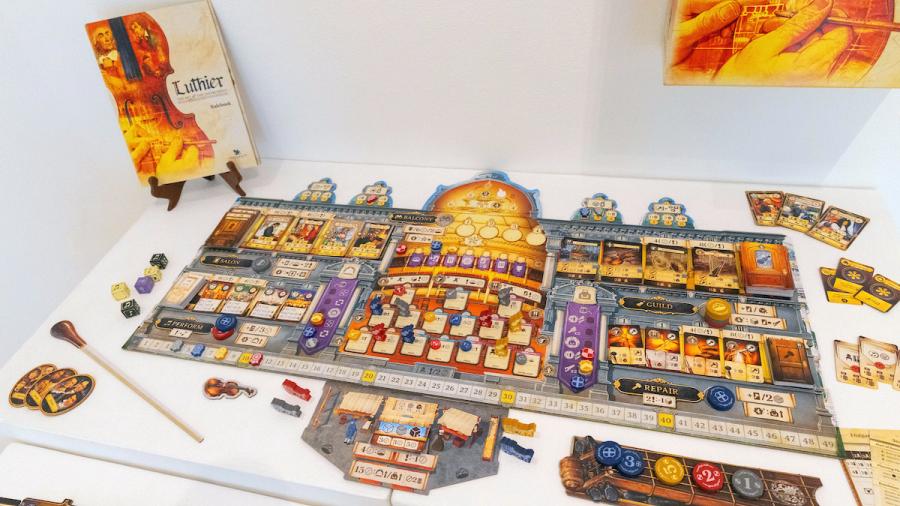
Just like his board game collection, Beck’s board game output didn’t stop at one. He co-designed a second game, Luthier, in which players take the roles of 18th-century instrument makers during the height of the classical music era. This meticulously detailed game hit the market in 2025 after another successful Kickstarter, which raised $790,000. Two more Paverson Games titles by different designers are now in the pipeline: Class of ’89, which focuses on creating a high school yearbook (with artwork by Evensen), and Ringyō, a forestry game set in feudal Japan (designed by former UW-Stout Lecturer Charlie McCarron).
UW-Stout game design students have also played a role in the business as paid interns. Most recently, Amanda Gagnon, a junior from Racine, interned for Paverson Games over the winter break. The internship reinforced skills Gagnon learned in her coursework, from updating and formatting files to assembling physical prototypes. The experience, she said, gave her a solid foundation in working on both digital and tabletop games.
“I think a lot of people that first begin to pursue a game design degree — myself included — start out really excited to create the art, the code or the narrative,” Gagnon said. “However, when you’re introduced to tabletop design, it really makes you focus on the mechanic design and player experience instead. Learning more about tabletop design and working with a tabletop company emphasized to me the importance of play testing and making sure players enjoy your game, which can sometimes get missed in digital game design.”
All of the Paverson Games titles rely on strong themes that attract players and keep them fascinated, not frustrated. “I believe very strongly in theme-driven design,” Beck said. “It’s something that not only helps people learn the game a little easier, because they can understand the real-world connection, but also it oftentimes will have more of a lasting impression that will allow you to really dive deeper into the art of that game as well to create that world for the player.”
Such focus has made Beck a success in both the classroom and the world of board gaming. “It’s crazy to think how one sleepless night can literally change your life,” he said.