



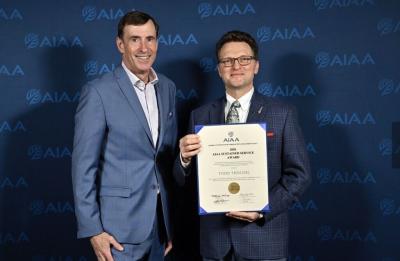
From advancing rocket propulsion systems to earning some of aerospace’s highest honors, Todd Treichel, Ph.D., has built a career defined by precision, persistence and impact. His work with Sierra Space and in collaboration with NASA supports mission-critical systems where failure is not an option, contributing to technologies used in spaceflight and national defense. His impact has been recognized with a NASA Silver Achievement Medal, a Kennedy Space Center Achievement Award and a 2026 sustained service honor from the American Institute of Aeronautics and Astronautics.
Treichel’s path to rocket science didn’t begin in a lab but a dairy farm. Growing up in a small community near Green Bay, Wisconsin, Treichel expected to take over the family farm and continue the hands-on work he loved. That path began to shift in high school, when his teachers and coaches noticed his potential and encouraged him to take the ACT, even though he hadn’t planned to. After performing well on the test and with encouragement from his family, Treichel began to see new possibilities. Support through his service in the U.S. Army and Army Reserve helped make college attainable, ultimately leading him to UW-Stout.
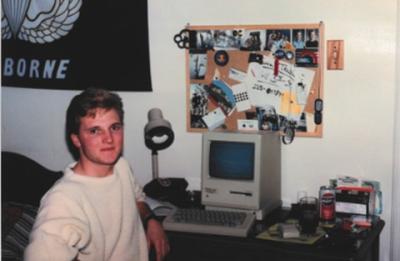
Even before its designation as Wisconsin’s Polytechnic University, UW-Stout stood out to Treichel. “It felt like the right fit,” he said. “Farmers are kind of scrappy engineers. You’re always fixing things or figuring out how to make something work better. That’s what Stout felt like to me.”
At Stout, Treichel balanced academics with his Army Reserve commitments, building discipline while navigating an academic path that was still taking shape. Once immersed in Industrial Technology and Manufacturing Engineering, he found himself drawn to the rigor of quality and process control.
In a challenging course focused on statistical process control, Dr. Wallace “Chuck” Carlson, a professor known for pushing students to their limits, recognized Treichel’s aptitude and encouraged him to go deeper. While others shied away from the difficulty, Treichel leaned in, a decision that would act as a catalyst for his career.
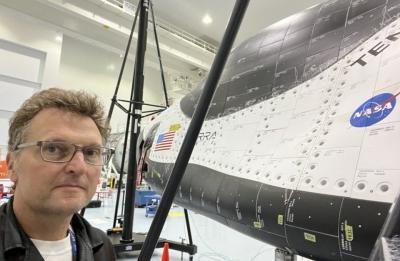
That foundation became critical in his first role at Philips Electronics. When a high-stakes government project required advanced reliability analysis, Treichel was asked to step into an engineering role. Relying on the statistical tools he developed at UW-Stout and with guidance from Dr. Carlson, he helped tackle the challenge. That moment marked a turning point, launching him into reliability engineering and eventually into test engineering, which became his pathway into aerospace.
Over the years, his work evolved from manufacturing systems to highly specialized aerospace applications, supporting projects tied to satellite systems and space exploration. At Sierra Space, he now focuses on the design, testing and reliability of rocket propulsion systems, the core technology that makes launch, orbit and deep space travel possible by delivering the thrust needed to escape Earth’s gravity and carry payloads, equipment and people safely into space. His work helps ensure critical technologies perform in the harshest environments imaginable.
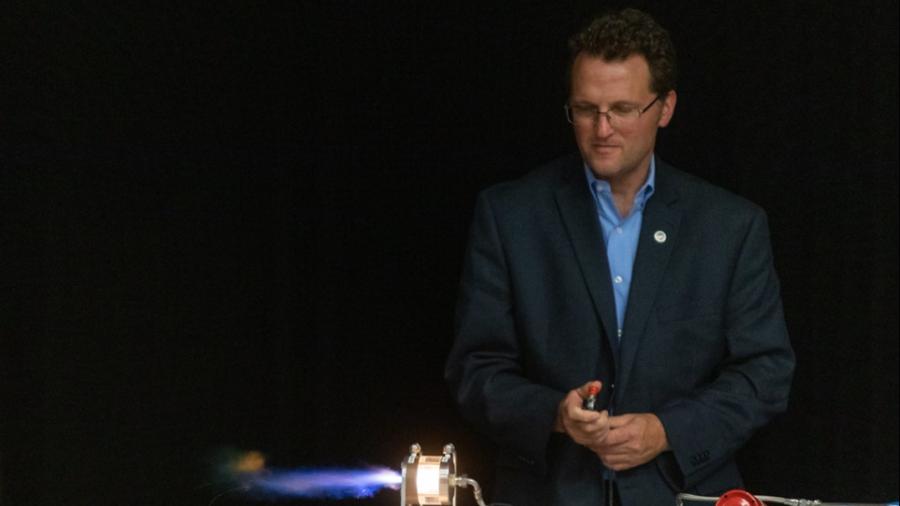
Treichel is currently involved in testing systems related to lunar dust exposure through a UW-Stout student-led project developing a lunar dust test chamber. The work focuses on how simulated lunar dust interacts with spacecraft components such as lighting systems designed for future lunar rovers. The project is helping evaluate how these conditions may affect hardware performance and guiding future design considerations for space exploration systems.
Beyond his professional work, Treichel has remained connected to UW-Stout through serving on the mechanical engineering advisory board, returning to campus to speak with students and actively mentoring future engineers.
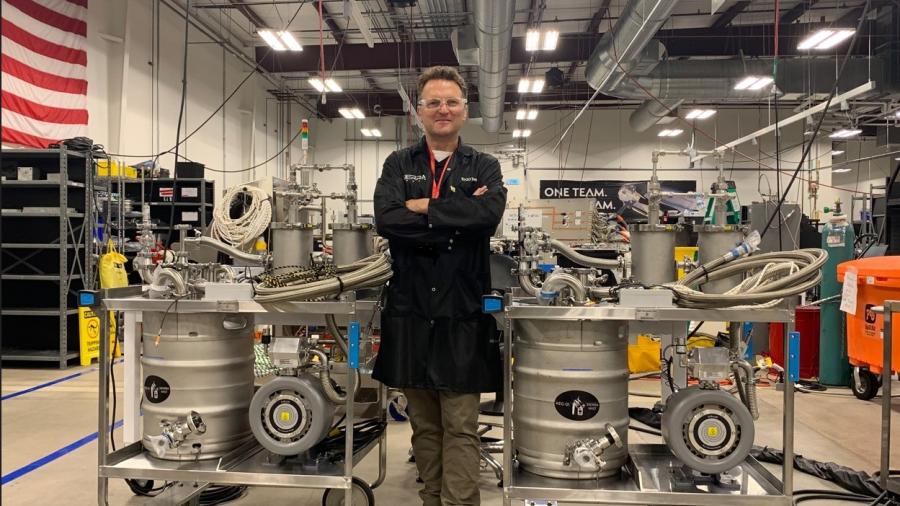
His impact extends even further through STEM outreach, where he works with students in the Madison and Milwaukee area to design and launch high-powered rockets, sparking interest in aerospace at an early age.
“It’s fun to see that spark,” he said. “Sometimes you don’t know if it makes a difference, but then you hear from a student who’s pursuing engineering because of that experience.”
For Treichel, that full-circle moment reflects what being #StoutProud is all about.
“Stout gave me the foundation and the confidence to step into things I hadn’t done before,” he said. “That’s something I’ve carried with me ever since.”
From a farm in rural Wisconsin to work that helps enable spaceflight and expand what is possible in space exploration, Treichel’s journey shows how a hands-on education, strong mentorship and a willingness to take on hard problems can shape technologies that reach far beyond Earth and open the door for what comes next.