





Student Andrea White, alumna Holland Houdek, Associate Professor Masako Onodera, Assistant Professor Vincent Pontillo-Verrastro and instructor Aric Verrastro had pieces chosen for the exhibit METALLOphone: BONDS, the Third International Biennial of Contemporary Metal Art.
The exhibit ran from Oct. 5-26 at (AV) 17 Gallery in Vilnius, a city of 2.8 million people and the capital of Lithuania. Artists represented Europe, Asia, Australia, North America and South America. The exhibited pieces “take visitors aback not only by the variety of shapes but also the unexpected combinations of materials” such as organic, synthetic or recycled items, said the exhibit website.
 Along with having one of his pieces chosen for the exhibit, Pontillo-Verrastro presented an online video lecture, NATURALLYdigital, Oct. 14 during the gallery’s Online Lecture Series. Other online lecturers were from Lithuania, Sweden, Estonia and the Netherlands. He addressed issues surrounding a natural predisposition and gravitation toward the use of digital platforms and the integration of digital fabrication techniques to the traditional studio practice.
The pieces exhibited by UW-Stout representatives were:
- “Sotil,” by Pontillo-Verrastro, made of wood composite and stainless steel. He incorporates digital fabrication, including 3D printers, into his works. “The term analogous describes the likeness that permits one to draw an analogy — an inference that two or more things agree with one another in some respects and will probably agree in others,” he said.
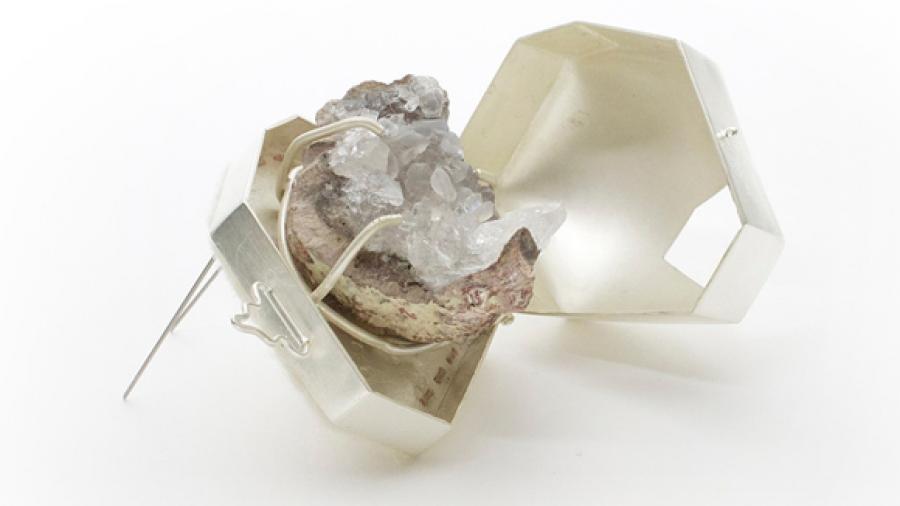
- “Light,” by White, of Menomonie, made of sterling silver, geode, wool felt and silk cord. “Throughout human history metal has been a means to communicate status and symbol. Metals have been instilled with different symbolic meanings by various cultures, yet each metal seems to carry its own common language that can be interpreted by anyone,” White said in describing her inspiration for “Light.”
- “Topology,” by Onodera, made of repurposed leather, parts from a silver-plated creamer, thread, cotton and silver. Old silver items from antique stores help tell a story, Onodera says. “Objects exist for decades, centuries or even millennia. Their functions transform over time from utilitarian to symbolic, from direct use by their owners to a ritual, indirect use. Despite their inanimate existence they stipulate a sense of space and time with their tactile and visual sensations. I am attracted to their quiet, flexible but robust presence. Objects are loaded with their stories and functions as well as the trace of hands that have touched them,” she said.
- “Horizon,” by Aric Verrastro, made of steel, copper, silver, stainless steel, thread, 23K gold leaf and acrylic paint. “The forms are architectural, modular, constructed from steel, becoming allegorical representations of the energy of a thriving, vibrant environment. The variations of forms show diversity and are linked to concepts of dancing lights and the beautiful musical chaos in the streets.”
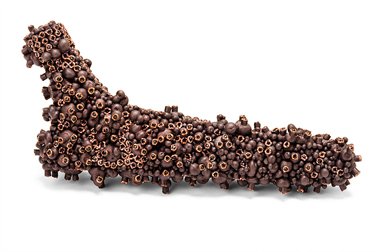
- “Femoral Stem with Rheumatoid Nodules, Hip Replacement,” by Houdek, a 2009 graduate, using mixed media. “This series focuses on medical implants, the body, and embodied experience. Medical implants are the bonds that hold broken bodies together, where metal fuses with organic matter to extend and improve the lives of millions of people. These hand-fabricated objects glorify the highly individual and personal nature of prosthesis and surgeries, while evoking notions of memento mori and the fragile nature of the human form. Using real medical implants as inspiration, I have reinvented and exaggerated these devices for imagined bodies. The intention is for the viewers to consider their own physicality and to visualize the absent anatomies implied by the work,” said Houdek, who teaches at the University of Iowa.
UW-Stout’s School of Art and Design includes a Bachelor of Fine Arts in studio art with an art metals concentration.
###
Photos
Bottom: Holland Houdek’s “Femoral Stem with Rheumatoid Nodules, Hip Replacement”