





A small black case rests atop a filing cabinet in Assistant Professor Kevin Dietsche’s office. He opens the case and begins strumming a ukulele. The soft music fills the office. Dietsche, an engineering technology instructor at UW-Stout, built the ukulele 15 years ago under the guidance of Kazukiyo “Jiggs” Kuboyama, a master in his craft who was honored by the Ukulele Guild of Hawaii.
In homage to Kuboyama, Dietsche tasked his own students to develop a process to build ukuleles in his New Product Development course this semester. “For me to do this is in honor of his tradition,” Dietsche said of Kuboyama, who was a 1957 UW-Stout industrial arts alum. He taught technology education in Oahu and passed away in 2019.
The project grew to also include developing toolless bed connections, with one group expanding their design to work across different furniture types – a solution allowing for flexibility of use.
The engineering technology and mechanical engineering students worked in cross-disciplinary groups to research market trends and materials and to ideate preliminary designs before they were joined by engineers and designers from Ashley Furniture Industries, including industrial and product design alums Caleb Toft and Anna Lindner, as well as Emeritus Professor Jerome Johnson, who viewed the groups’ design presentations and provided insight based on their industry experience.
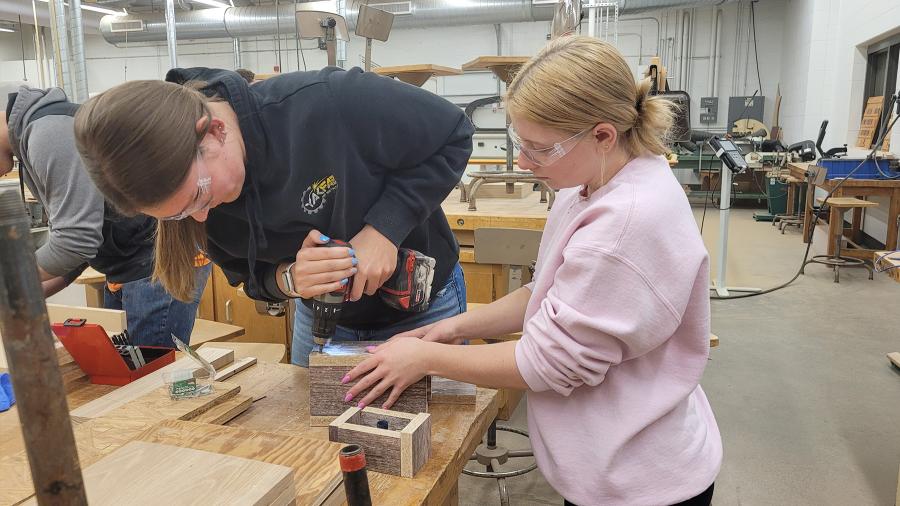
The groups then began their build process of the ukuleles and toolless connections in the Jarvis Hall Technology Wing Woods Lab.
“These projects are about teaching the students problem solving through the design process. The most difficult part is getting your first draft right. Once you’ve troubleshooted everything, you can build hundreds of models using your programming,” Dietsche said.
Creating ukulele building kits for beginners
The ukulele groups are meeting the challenge of making instrument-building kits more accessible to beginners. Two groups – Andrea Smith, of East Troy, and Brook Derks, of River Falls; and Konnor Kraft, of Plymouth, Minnesota, Alex Ogno, of DeForest, and Braden Kapitz, of Athens – researched ukulele construction methods, dimensions, and kerfing techniques, and how wood type and body shape affects sound quality and buildability.
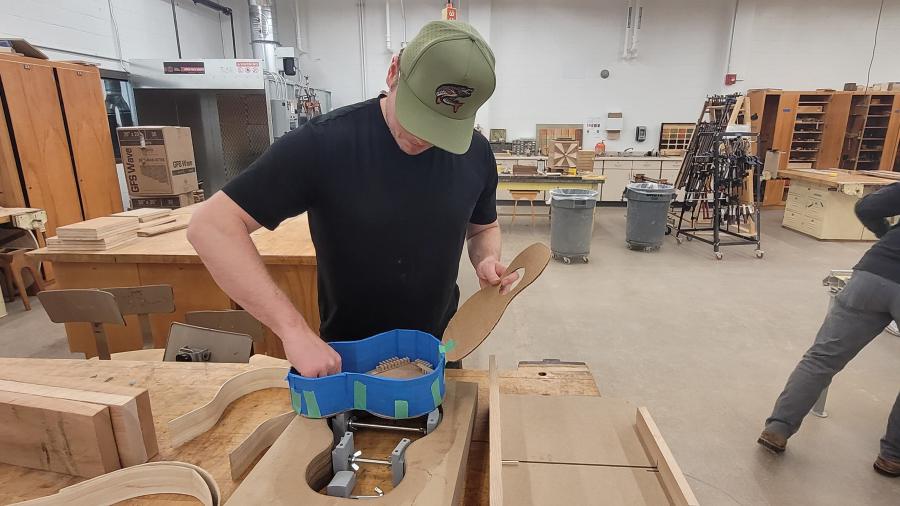
“Traditional instrument construction requires a high level of craftsmanship, which can be difficult for those with limited woodworking experience. Our goal is to simplify the process so anyone can successfully build a ukulele using guided methods and fixtures,” Smith said.
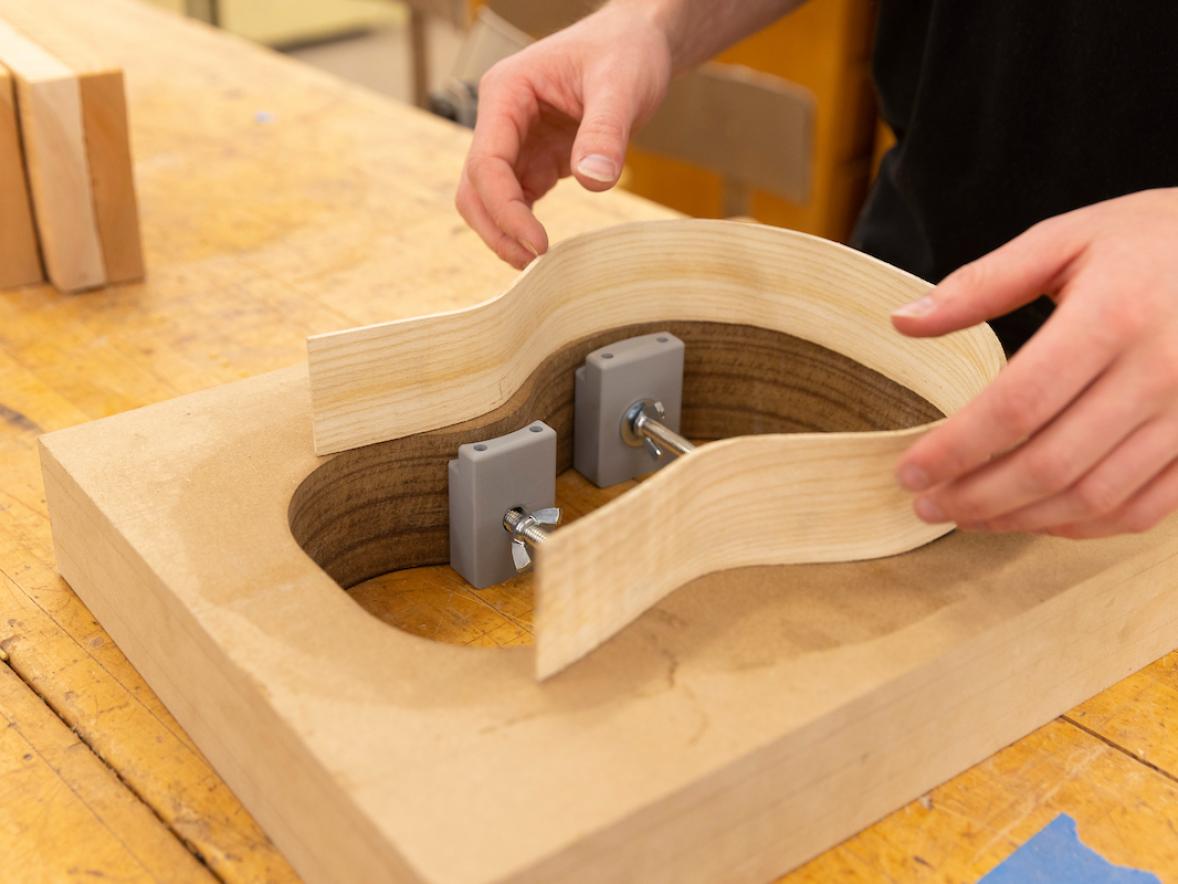
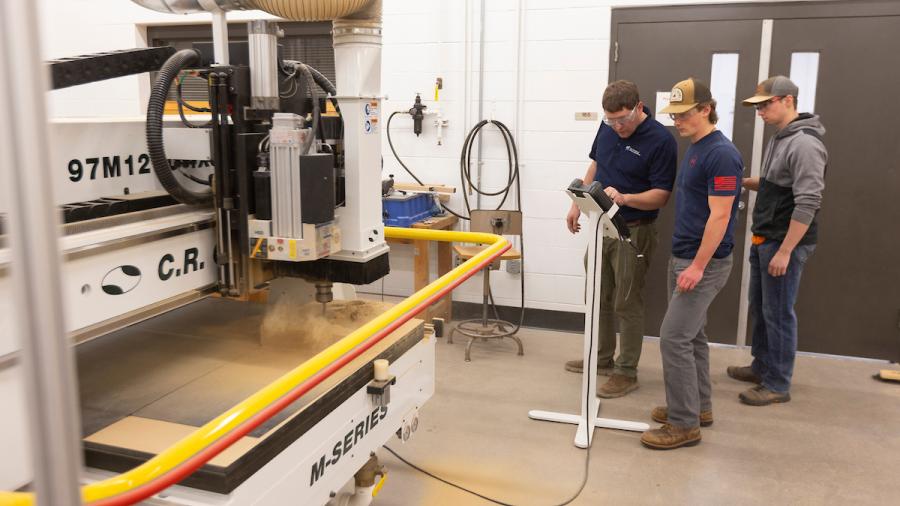
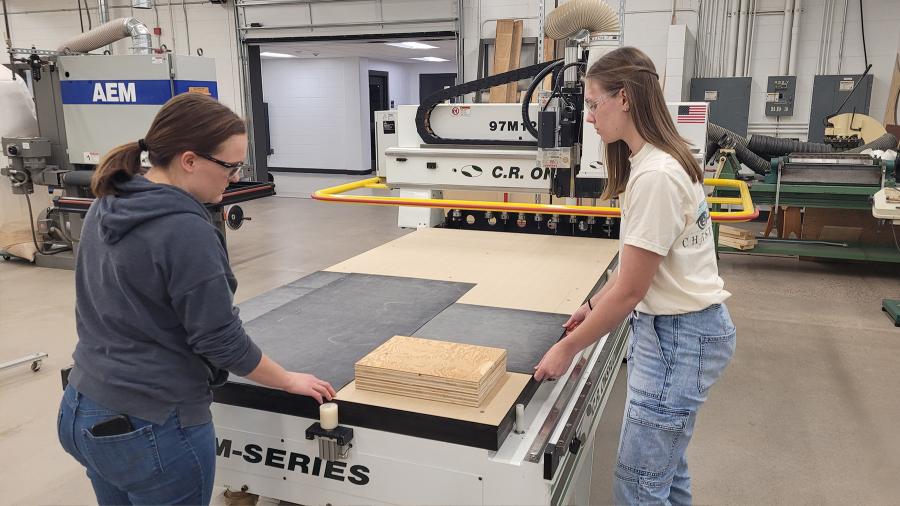
The groups designed main jig blocks in SolidWorks to match the size and shape of a ukulele and then, using AI contour construction, they removed the inner material on a CNC machine to make the manufacturing process more consistent and repeatable.
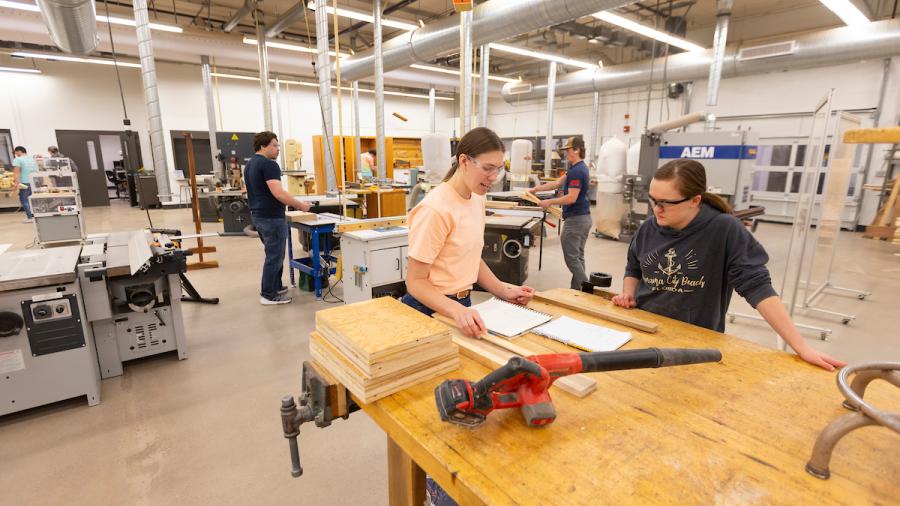
“We then steamed .08-inch-thick strips of ash wood for 45 minutes to make it malleable and clamped it to the inside of the main jig block for 48 hours to create the exterior curve of the instrument,” Kraft said. “The quality of the wood can affect how it curves, as well as how long it is steamed. We found that 45 minutes in the steamer was optimal for malleability, and that knots will affect the wood’s strength. It will weaken and split at the knot when curved.”
The groups also made kerfing supports (flexible, notched wooden strips glued to the inside of the ukulele body to strengthen the structure). “The top of our ukulele will be made of spruce for sound quality and the neck will be made of cherry wood for its vibrant color,” Kraft said.
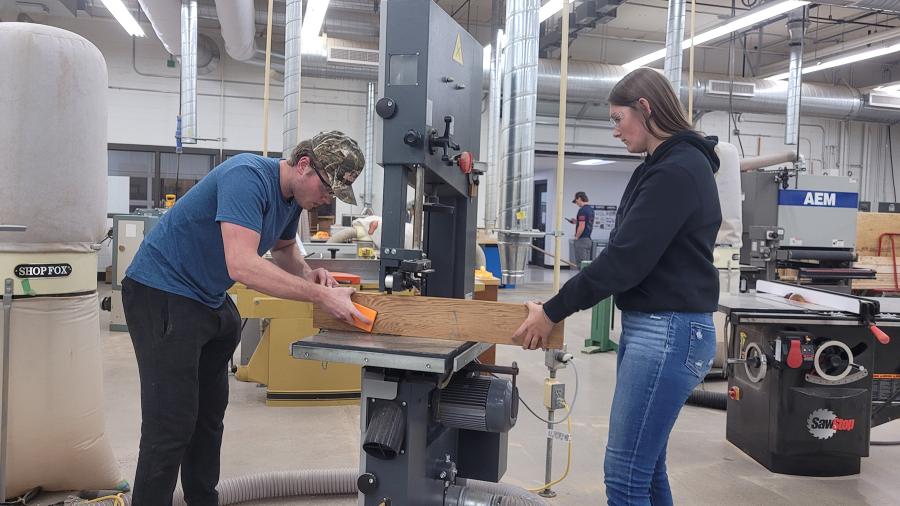
Smith and Derks expect bending the wood sides and achieving consistent kerf cuts to be challenging, since both directly affect the shape and structural integrity of the ukulele. “Designing jigs that ensure accurate alignment and repeatability has also required careful planning. We’re looking forward to testing to see how well our designs perform and what adjustments may be needed,” Smith said.
She’s enjoyed researching everything that goes into making a ukulele and understanding how each component affects the final instrument. “It’s been especially rewarding to take that knowledge and apply my design skills to create something that actually works. Seeing the transition from research to a functional build has been the most satisfying part of the process,” Smith said.
Simple, functional, attractive and mass-manufacturable designs
One of the toolless connections groups – Alex Dill, of Hartland, Aden Story, of Holcombe, and Bethany Winge, of Cottage Grove – first worked to identify ways that toolless assembly works in conjunction with a flatpack bed frame (a bed designed to be deconstructed into individual components). They then compared their drafted ideas to existing market solutions.
“We found that a flatpack frequently involves various methods that have self-aligning or self-maintaining joinery. From there, we began to brainstorm connection methods that involved self-contained components, or single-step customer assembly and disassembly items,” Dill said.
From Toft and Johnson’s critiques, the group thought the most interesting was to remember how material affects customer perception and quality of an item. “For example, a nicely finished piece of stainless steel has a much more premium feel than injection molded plastic,” Dill said.
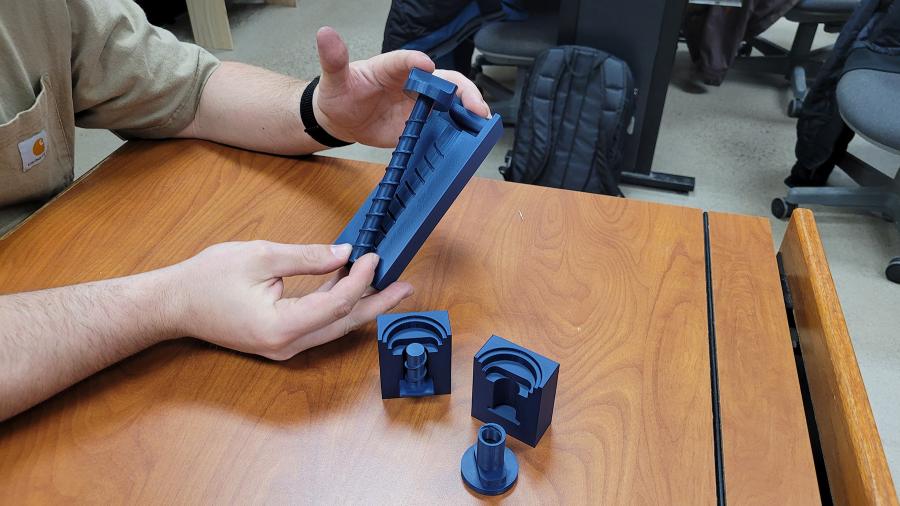
Dietsche required the toolless connection groups to produce their designs with three different manufacturing methods and materials. Dill, Story, and Winge’s thumbscrew and locking head device is intended to work across different furniture types.
Their methods and materials include: 1.) a 3D-printed component, designed in SolidWorks and printed by Story on his home 3D printer; 2.) a poured epoxy component, produced using a two-part casting rubber mix; and 3.) a metal component, based on availability and machinability, such as stainless steel and aluminum, and cut out by Dill on the CNC machine in the Machine and Subtractive Processing Lab in Fryklund Hall.
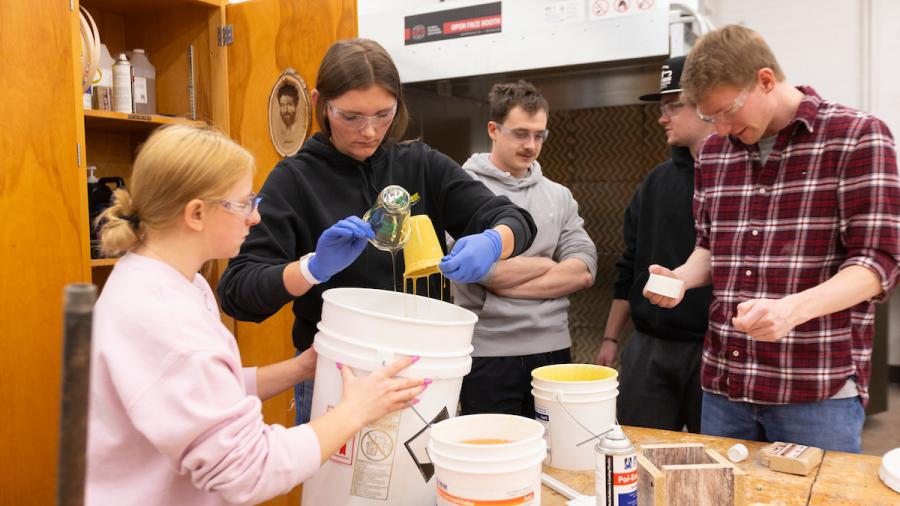
“The epoxy pour makes everything more repeatable in the manufacturing process. And our 3D-printed component is very well designed and thought out. But I think the metal component would sell the best in the real world,” Winge said.
The challenging part is almost always coming up with a design, as it needs to be simple, functional, attractive, and most importantly, mass manufacturable, Dill said. “Professor Dietsche facilitates a phenomenal environment to learn about CNC programming and other shop processes. Being able to go out in the lab and make things while learning how on the fly has proven very fun and interesting.
“More people should take technical manufacturing classes, as they build an appreciation for how the world around us is made,” he added.
UW-Stout’s engineering and technology department offers six undergraduate degrees, including computer and electrical engineering, manufacturing engineering, mechanical engineering, plastics engineering, engineering technology and packaging, as well as four minors and a master’s in manufacturing engineering.
Technology education is offered through the School of Education, which is home to nine undergraduate degrees, five graduate degrees, certificates, certifications and online professional development courses.