





Bill Moran’s art is being seen in one of the world’s most significant cultural institutions. His LetterFish — intricate fish created from letters, numbers and typographic symbols — are featured in AQVA – Catastrophe and Wonder, a water-themed exhibition at the Vatican Library in Rome. Moran created 12 LetterFish and two sculptures for the exhibition, which opened to the public Sept. 25 and runs through May 14, 2027.
The Vatican exhibition adds another chapter to Moran’s decadeslong work of bringing typography to new audiences. His work has been exhibited in the United States and Europe, including at the Gutenberg Museum in Germany and Tipoteca Italiana in northern Italy. His Letterbugs are part of the permanent collections at both museums, institutions dedicated to preserving the history and craft of printing.
For Moran, the opportunity grew from a lifelong fascination with letters and a family history rooted in printing. “I grew up in Green Bay in a print shop,” Moran said. “My dad, my grandfather and my brother were all printers.”
Moran began exploring art in high school through calligraphy, eventually discovering that he could use letters as visual elements rather than simply words. That interest followed him to UW-Stout Polytechnic, where graphic design students worked alongside students studying product design, art education and fine art. Moran took drawing and printmaking classes with students across those disciplines, an experience that helped blur the boundaries between art and design.
Professors Sue Hunt, Paul DeLong and Rob Price also left a lasting impression. More than four decades later, Moran remains in touch with his former professors and credits them with helping shape the artist and designer he became.
After graduating, Moran moved to the Twin Cities, where he worked as a graphic designer, eventually running his own studio. His family’s print shop closed in 2004, leaving Moran with access to its equipment and type.
“I thought, I can make things with these letters,” he said.
That idea became Letterbugs, typographic insects he began creating in 1999 using traditional letterpress tools, wood and metal type. The work opened doors to museums and collections across the United States and Europe, bringing historic type and the possibilities of typography to audiences far beyond the print shop where Moran grew up.
Moran also began working at the Hamilton Wood Type & Printing Museum in Two Rivers, Wisconsin, first as a volunteer and later as artistic director. The museum’s collection includes more than 1.5 million pieces of wood type, giving Moran an extraordinary range of historic letterforms to work with.
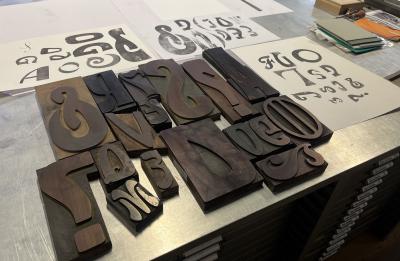
His work at Tipoteca eventually brought an unexpected opportunity. In 2025, representatives connected to the Vatican Library reached out with a simple question: Would he make LetterFish for the Vatican?
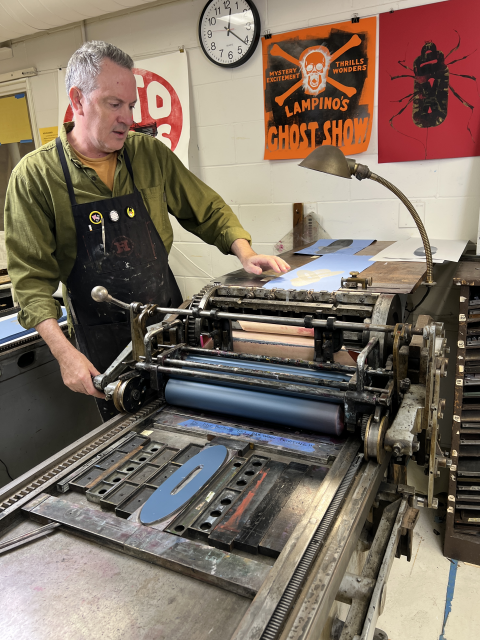
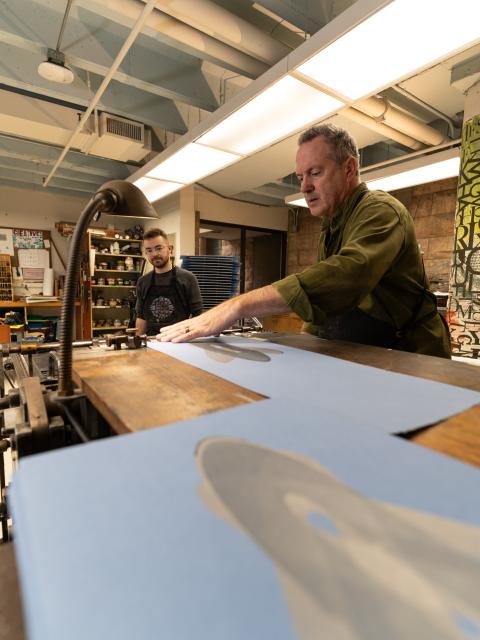
For Moran, that was an easy yes. He returned to Tipoteca and printed hundreds of individual letters from the Art Nouveau period, looking for shapes that could become fins, eyes, tails and other parts of fish. He combined traditional printing with digital tools, arranging and photographing letters, scanning them and creating new plates before printing the final pieces on a century-old press.
Moran’s work asks viewers to look differently at something they encounter every day: the alphabet. A letter can communicate a word, create a shape or become part of something entirely unexpected.
“I want you to be able to go back and forth between, ‘That’s a letter M,’ and ‘That’s a fish tail,’” Moran said. “I want people to use their imagination.”
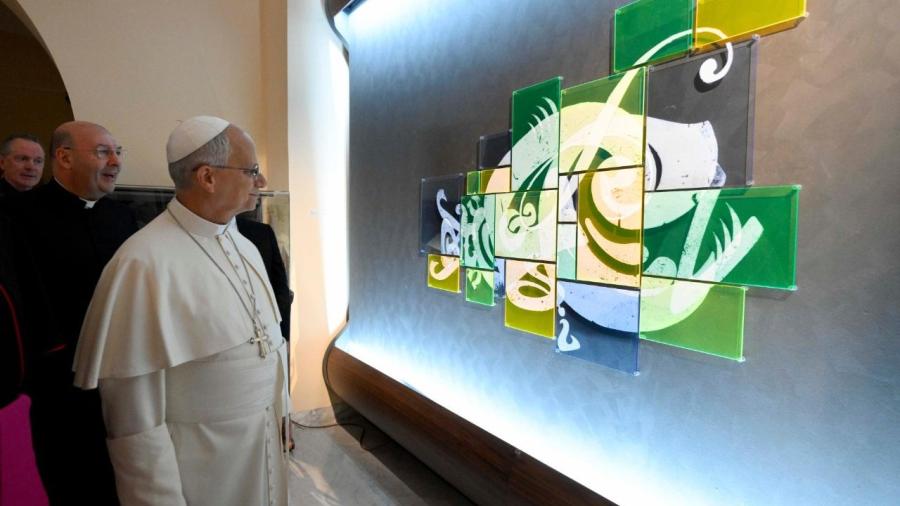
During the exhibition’s opening week, Moran demonstrated letterpress printing in the Vatican Library courtyard, allowing visitors to create their own LetterFish. He also taught his graphic design history class over Zoom from inside the library, giving his students a glimpse of its historic books and manuscripts.
In doing so, Moran is carrying the history of printing into new contexts and giving people new ways to engage with it. His work connects centuries-old type, contemporary design and hands-on making, helping keep the craft of letterpress and the visual language of typography accessible to new generations.
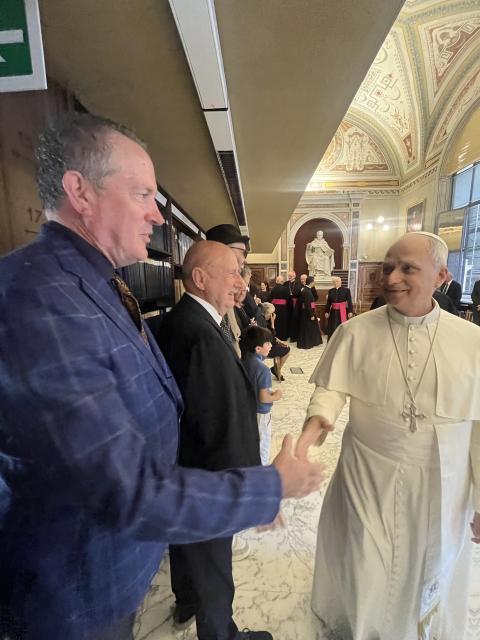
Moran even had the chance to meet Pope Leo XIV during the exhibition’s opening. For Moran, however, the most meaningful part of the experience was being surrounded by people dedicated to the Vatican’s restoration work and the care taken to keep centuries-old books available for future generations.
That connection between making, teaching and sharing is central to Moran’s work. He describes his three-word mission as “shared visual culture” — the idea that typography, design and art are part of a living visual language that everyone can explore.
That mindset traces back to UW-Stout Polytechnic and the professors who encouraged him. More than 40 years later, their influence is still visible in the way Moran approaches his own work and in the way he teaches the next generation of designers.
“What makes me StoutProud? Boy, that would have to be the impact that my teachers are still having on me,” he said. “Good teachers are a good thing. And I had some especially good ones at Stout.”
He carries that influence forward by encouraging students to experiment, look at familiar things differently and find their own place on the spectrum between design and art.
Explore Moran’s LetterFish and create your own at letterfish.net.