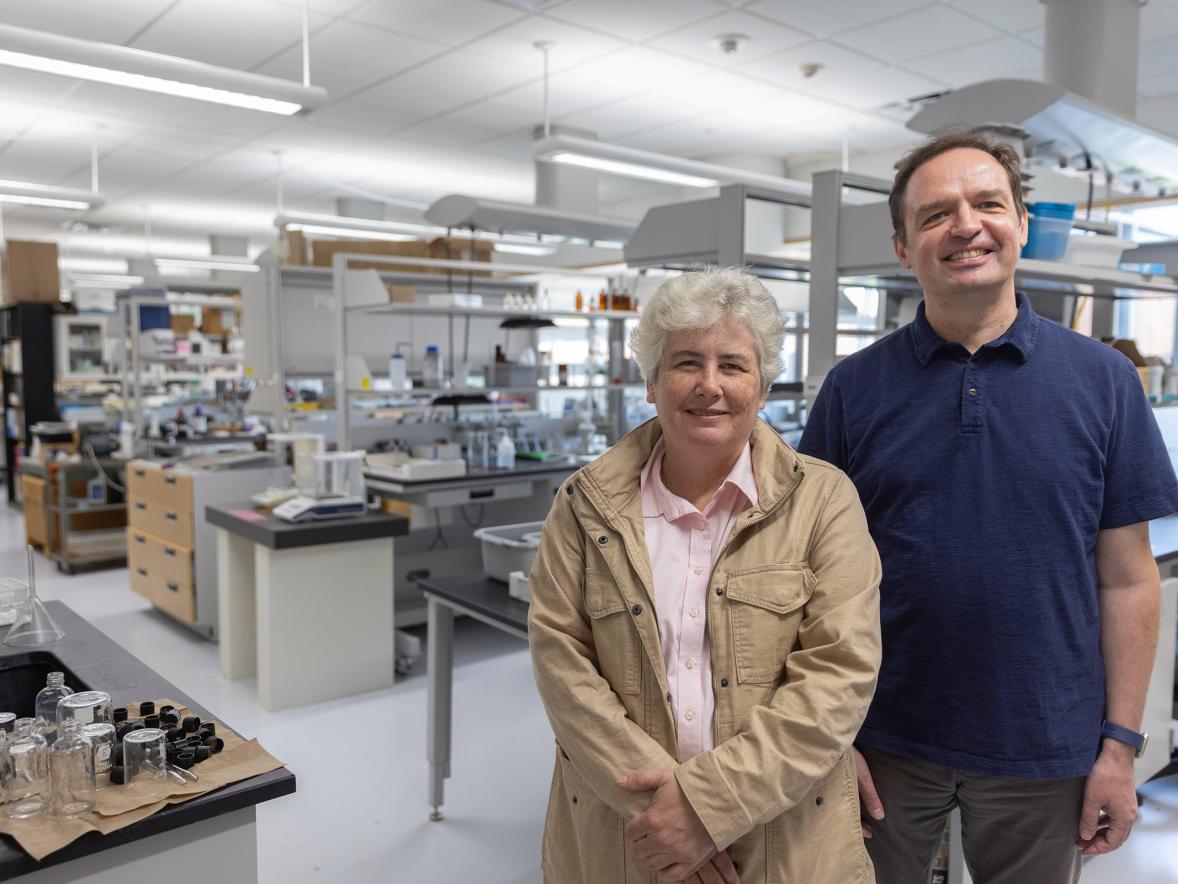






More than a decade of work by two UW-Stout Polytechnic faculty members and their student researchers has led to a newly patented process that allows for the easy detection of an amino acid linked to multiple sclerosis, rheumatoid arthritis and potentially cancer.
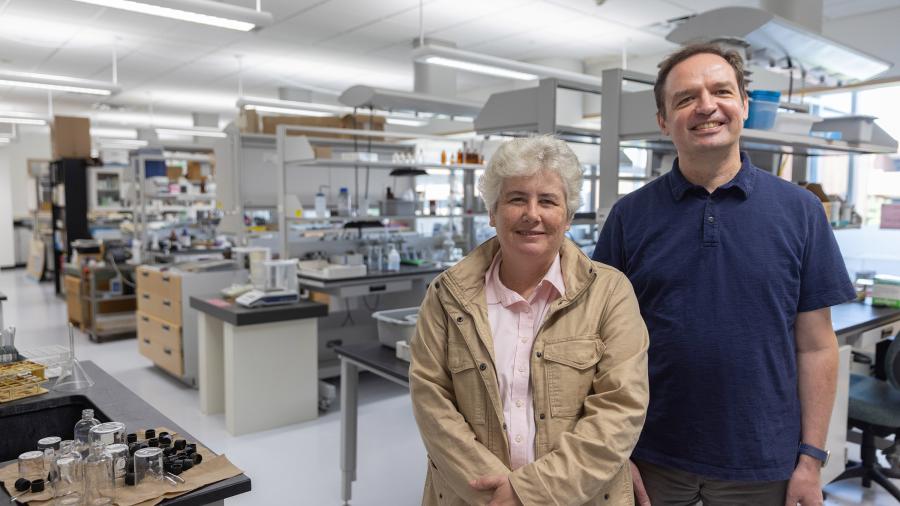
Biochemistry Professor Jennifer Grant and chemistry Professor Dmitry Kadnikov recently received official word from the U.S. Patent and Trademark Office that their patent for an improved chemical probe for detecting citrulline has been formally granted. This amino acid is an indicator of autoimmune diseases, such as M.S., as well as a number of neurological disorders, cancer and immunity in general.
Despite its importance – citrulline also plays a role in DNA transcription – it is difficult to detect: The modification that creates citrulline only adds the weight of one hydrogen atom to a protein, and available chemical probes were cumbersome and costly. Researchers were discouraged by these factors, and citrulline detection remained a rarely explored subject.
Grant has been intrigued by citrulline since she worked as a postdoctoral fellow 20 years ago. She saw how a chemical process to detect citrulline more easily could work in theory but learned that the sole researcher who had been investigating the process had moved on to other topics.
“I started thinking about this, and I realized I’ve got a pretty good organic chemist as a colleague,” she recalled – and thus began a more than decade-long partnership with Kadnikov to develop the new detection process.
The now-patented process occurs in two steps: First, a small, sensitive chemical probe latches onto the citrulline. Then, a chemical tag is added, attaching to the probe and making it easier to detect. Crucially, the kind of tag can be modified to meet a researcher’s needs. It may be an antigen, a nanoparticle or even a fluorescent tag useful for imaging. Grant compares the process to a factory using interchangeable parts.
“Once we have the citrulline roped in, so to speak, we add any reagent we want to,” she explained. “That is the real novelty of the project.”
The professors’ research has been boosted by grants from WiSys, the Universities of Wisconsin technology transfer agency, and the work of numerous UW-Stout Polytechnic students who have assisted with research in their labs. For example, two biochemistry alumni – Dylan Meyer, now a senior research scientist at Vertex Pharmaceuticals, and Justin Olson, a senior data scientist at Alpha Theory – co-authored a scientific paper with Grant. The paper, published in the journal Computational Biology and Chemistry in 2017, identified several motifs – specific sites on a protein residue that are converted to citrulline.
Such undergraduate research experiences aren’t exceptions at UW-Stout Polytechnic, where applied learning and research are core to the university’s polytechnic identity. On campus, labs and studios outnumber traditional classrooms by a 3-to-1 ratio, and 100% of Blue Devils graduate with applied learning experiences.
In addition to their expertise in the lab, Kadnikov and Grant had to cultivate patience during the patent process. Their application was submitted in 2020, published in 2022 and cleared the final technical and legal hurdles just this year. Now that it has been approved, the professors hope the invention will be used by scientists around the world researching autoimmune diseases and other ailments.
Grant also looks forward to continuing work on citrulline at UW-Stout Polytechnic.
“As a biochemist, where my first thought is to try and understand the natural system, I wasn’t ever setting out to get a patent – so this is a real milestone,” she said.