





Jacob Schwitzer (’20) has been named UW-Stout Polytechnic’s Rising Leader for helping Indigenous students feel seen and bringing modern Menominee stories into classrooms and communities, changing the way people experience culture, storytelling and connection through video games.

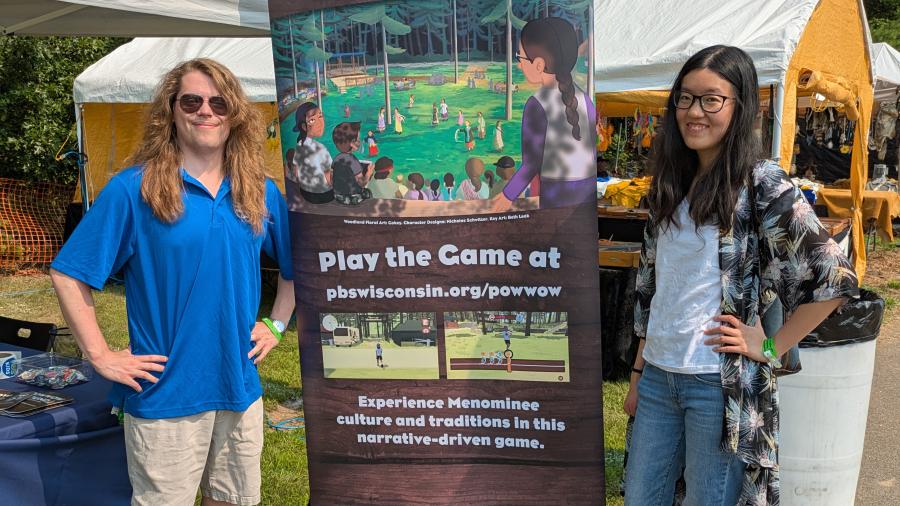
His game, Powwow Bound: A Menominee Homecoming, immerses players in the story of a Menominee family returning to their reservation for the Annual Contest Powwow. Along the way, players explore language, family and tradition, guided by a story that is both deeply personal and culturally authentic.
“I hope Native students feel seen in a medium that doesn’t often share our stories. And I hope others gain a deeper understanding of what modern Indigenous life looks like,” said Schwitzer, of Shawano, a first descendant of the Menominee Nation, who grew up on Legend Lake near Keshena, on the Menominee Indian Reservation.
“It is a special, humbling honor to receive the Rising Leader Award from the UW-Stout Foundation & Alumni Association. I would not be here without the support of my family, friends and community,” Schwitzer said.
“I’m especially grateful to Barb Miller, former director of UW-Stout Polytechnic’s Multicultural Student Services, for nominating me for this award. Barb is a member of the Menominee Tribe as well, and I have been blessed to know her for the better part of 10 years. Her guidance and support during my time at Stout helped me succeed and kept me on the right path. Through her nomination, I know I am still on that right path and hope I can continue to repay the kindness she has shown me. Māēc Wāēwāēnen (Thank you so much), Barb!” he said.
Schwitzer’s path to creating meaningful, community-centered games led him to UW-Stout Polytechnic’s computer science program. After earning his degree, along with a concentration in game design and development and a minor in mathematics, Schwitzer struggled to find a job in the midst of the COVID-19 pandemic. While looking for a full-time job, he was able to participate in a summer internship program at the College of Menominee Nation’s Sustainable Development Institute.
“I continued the work I had done for my previous internships at that institute, creating virtual reality (VR) applications that blend Indigenous traditional ecological knowledge with ongoing ecological research at Penn State University,” Schwitzer said.
After completing his work over the summer, Schwitzer continued his job search and found his current role at Nebraska Public Media as a software developer, creating interactive experiences through VR, web applications and 360-degree video documentaries.
“Eventually, my role grew to include designing, developing and producing video games for Nebraska Public Media, resulting in my first professional production, Powwow Bound: A Menominee Homecoming,” Schwitzer said. “Powwow Bound is a deeply personal project based around my tribe’s culture and traditions with the express purpose of creating a modern, authentic depiction of Indigenous peoples in video games.”
The game was inspired by Schwitzer’s mom, Lela Schwitzer, an enrolled Menominee and first-grade teacher. “She is always looking for meaningful resources to help teach Act 31, Wisconsin’s requirement to teach students about Wisconsin’s Indigenous peoples. When the opportunity arrived to make a game about my tribe, the Menominee Nation, I knew that I wanted to create something that depicts us in a modern, authentic context,” he said.
Schwitzer started by ideating with his family. Together, they outlined how to showcase their culture and discussed how this could benefit classroom and general use. Schwitzer then brought it back to the teams in Nebraska and Wisconsin to further develop it with them and other tribal members.
Community collaboration and authenticity were integral to the development process. A Menominee writer, cultural advisers and Menominee language speakers helped ensure accuracy and depth. Nicholas Schwitzer (’20), Jacob’s twin brother, served as character designer, making sure the characters reflected Menominee identity without relying on stereotypes. His younger brother Matthew lent his voice to the project, and his mother, Lela, helped develop the accompanying educator guide.
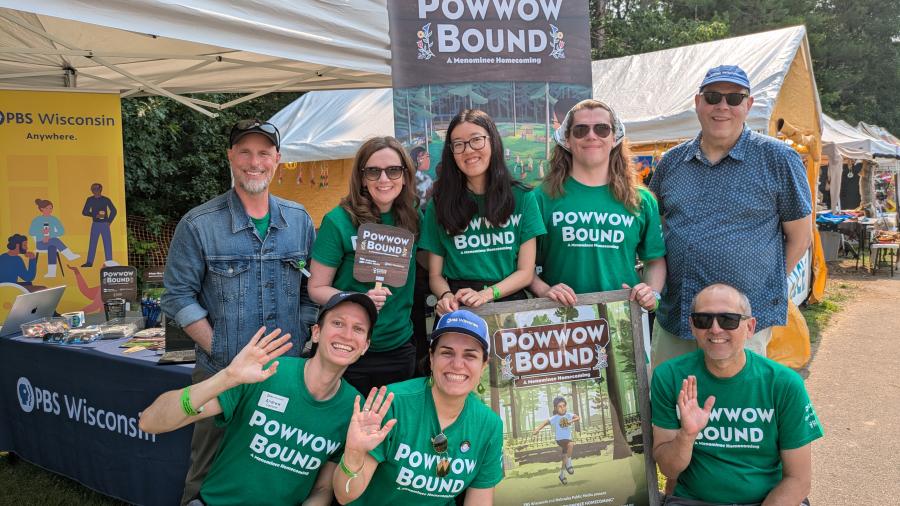
Schwitzer and the creators of Powwow Bound launched their game at the 57th Annual Menominee Contest Powwow in 2025. They were joined by PBS Wisconsin Director of Television Jon Miskowski and co-producer Angelina Shi.
“It means the world to me to see young people connect with stories that reflect their own communities and experiences. I was especially happy to hear young players talk about the characters and locations with joyful familiarity. Hearing them say, ‘They look like me!’ and ‘I dance like that!’ showed me that we accomplished our goal of authentically depicting the tribe. Kids deserve to see earnest depictions of their own lives to ensure that they feel seen and heard, so I’m glad that this game can accomplish that for young Indigenous players,” Schwitzer said.
The impact of the game has been immediate. Young Indigenous players have seen themselves represented in its characters and storylines, while educators are using it to support Act 31 instruction. Players of all backgrounds are gaining a deeper understanding of Menominee culture and traditions.
Schwitzer was invited to join the Digital Immersion cohort of public media workers developing digital-first projects and was named one of Current: News for Public Media’s 2023 Rising Stars. He has presented his work on Powwow Bound at game development conferences around the country. “These opportunities would not have been possible without the support I’ve received from Nebraska Public Media and the education I received from UW-Stout Polytechnic. I am grateful for the support I received from my co-workers, my family and my tribe in the creation of this game,” he said.
Schwitzer’s leadership skills have grown immensely since taking on this project. He’s learned to better communicate across game development disciplines, gained hands-on experience with project management and maintaining project goals, and discovered how to align the vision of a project across multiple collaborative entities.
“As I continue to work through new projects, my newfound skills have allowed me to better collaborate with my co-workers and have broadened my horizons for my role at Nebraska Public Media,” he said. “My goals are to continue creating games that fulfill the mission of public media; to enrich the lives of our communities and educate the members within them. I am hopeful that I can do so by supporting the work of my co-workers and eventually stepping back up to the plate for the next production I will lead.
“I see my role in the industry as an advocate for the good that public media and independent game developers can accomplish with the appropriate support. I am hopeful that my work at Nebraska Public Media and our partnership with PBS Wisconsin can continue to show what is possible if we work collaboratively. I am hopeful that I can invite independent developers into that circle and create games that add value to our players’ lives,” he said.
Longterm, Schwitzer would like to develop a process that allows independent game developers to promote and distribute their work through public media, like Nebraska Public Media’s existing approach to independent film distribution. “I believe that this approach shines a light on smaller games with immense value that can bring joy to our audiences,” he added.
Schwitzer thinks his applied learning experiences in UW-Stout Polytechnic’s game design and development program allowed him to gain the necessary skills needed to succeed in his career in game development and public media. “By working on game projects every year of my schooling, I refined my programming, communication and collaboration skills. That combination of hard and soft skills set me up for success when I joined the industry after graduating,” he said.

The mindset that has helped Schwitzer be successful is one of his favorite movie quotes from “Back to the Future.” “‘If you put your mind to it, you can accomplish anything.’ That approach of dedicating one’s mind to a goal and finding all possible pathways to achieving it has helped me so much through college and in my early career.
“It is also important to ask for support when you need it. I have asked my friends, family and community for help many times, whether it’s been to bounce ideas off each other, asking for guidance on how to approach a difficult process or gathering feedback for games I’ve developed. I’ve been grateful to receive that external support and provide it for others as well,” he said.
Whenever he faces setbacks in life, Schwitzer remembers a lesson learned in Professor Aaron Durst’s Jazz Band: Improvise.
“Improvising does not mean panicking and randomly picking a new course of action; it means being constantly aware of any situation and ideating what to do if you suddenly need to change plans. When something doesn’t go as you expect or takes an uncertain turn, pivot your plan to address the challenge head-on. You cannot ignore the issue and expect it to resolve itself. You can only move forward by incorporating the change and overcoming it,” he said.
A challenge Schwitzer encountered early in his career was taking on too many responsibilities at one time and quickly burning himself out. “I was young and eager to prove myself at work, but I failed to recognize that I could share the work with others in my department,” he said. “This taught me that a balanced workload is a healthy workload and that, over time, you will eventually train yourself to tackle multiple heavier workloads in a healthy and productive way.”
Schwitzer stays connected with the UW-Stout Polytechnic community by keeping in touch with friends and supports game design classmates’ projects online and in person. He also connects with students at various state and national conferences. “I’ve been grateful to connect with them, share my experiences in the industry with them, and offer them advice for what to look out for after graduating,” he said.
For students looking to enter the games industry, he said, “Our industry is wide reaching and there are many unique approaches for students to utilize their degrees. In a time when it feels like the industry is shrinking and job losses are especially prevalent, students should look for opportunities that are off the beaten path of mainstream games,” Schwitzer said. “I was able to find my current role because of my experience with VR and step into Nebraska Public Media to assist with their interest in exploring 360-degree video and immersive experiences. That opportunity, and my game development knowledge, allowed our station to feel comfortable in experimenting with games, leading to this project and our new games-centric vision for our department.”