





For his generous service to the Menomonie community and his inspirational mentorship and philanthropy to UW-Stout Polytechnic, Howard Lee (’68, ’69) has received the Luminary Alumni Award.
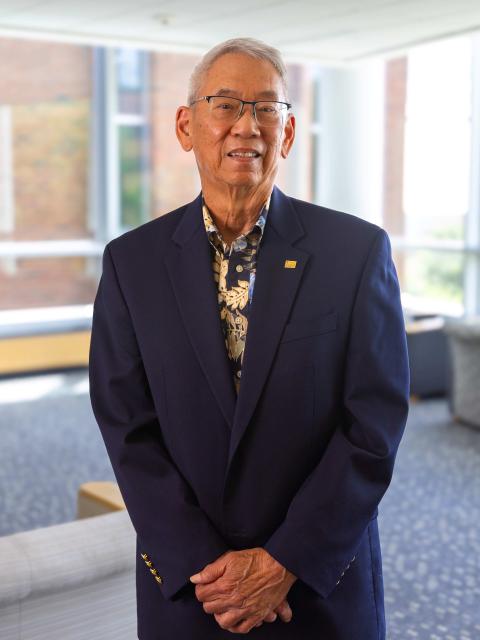
Throughout his career, Lee elevated UW-Stout’s national reputation in career and technical education, strengthened partnerships with industry and community organizations and positioned himself as a respected voice and advocate.
His influence as a mentor is profound; countless students, faculty and emerging leaders credit him with shaping their professional paths and instilling in them the values of integrity, service and excellence.
In 2025, Lee and his wife, Charlotte Gomulak Lee (’67, ’68), were named Knights of Columbus Monsignor Blecha Council 2055 Family of the Year and Outstanding Dunn County Philanthropists by the Dunn County Chippewa Valley Fund Raising Professionals.
“Helping others and meeting new people gives me satisfaction. Everyone can make a difference. Just make the time and do it. As long as I can volunteer, I will continue. It’s a great honor to be recognized for the things I have accomplished and how I may have made a little difference,” Lee said. “If you can find a partner to share things with, then you will have a good life. Charlotte has been at my side the past 58 years.”
Lee grew up in Honolulu, Hawaii, and after graduating high school in 1961, he enlisted in the U.S. Army at age 17. After basic training, he attended ordnance school at Aberdeen Proving Grounds and served his remaining three years in Verdun, France, when he visited 11 European countries.
Upon returning to Hawaii, he attended the Honolulu Technical Institute, majoring in auto body. “During my first term, Yaso Abe (’47), a family friend who had graduated from Stout with an M.S. degree after the war, suggested I attend Stout and be an industrial arts teacher,” he said.
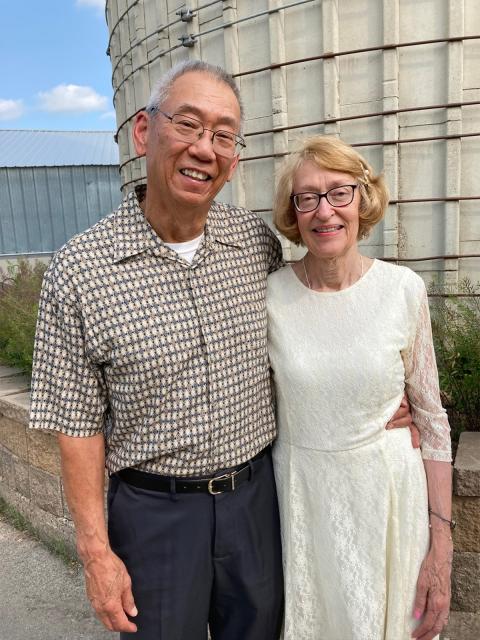
Lee earned his B.S. in industrial education in 1968 and his M.S. in industrial education in 1969, receiving GI benefits during his four years at the university.
He was an active member of Alpha Phi Omega, the service fraternity at Stout. He was also a member of the Epsilon Pi Tau fraternity and served as a graduate assistant in the industrial graphics department.
“There were so many great instructors at Stout to learn from. They influenced what and how I taught, and how students should be treated. I observed Stout instructors and how they worked together, and it left me with a lasting impression,” he said.
Lee met Charlotte on his second day at Stout. They married in 1968 and started teaching in White Bear Lake, Minnesota, the following year: Charlotte in family and consumer education and Lee in industrial education, mainly auto mechanics, small gas engines and drafting. After two years, White Bear Lake opened a new high school, and Lee’s responsibility was to work with the architect on the power and drafting labs, ordering equipment, and developing the curriculum to justify the laboratory and equipment.
“I had so much fun teaching high school students developing learning activity packages, programmed instruction and self-learning audio activities,” he said. “When I first started teaching, I asked students to complete a simple two-question evaluation: What is going well in class, and what should I do differently? Getting feedback from people you work with is very important. Treat faculty, staff, students and community members how you wish to be treated.”
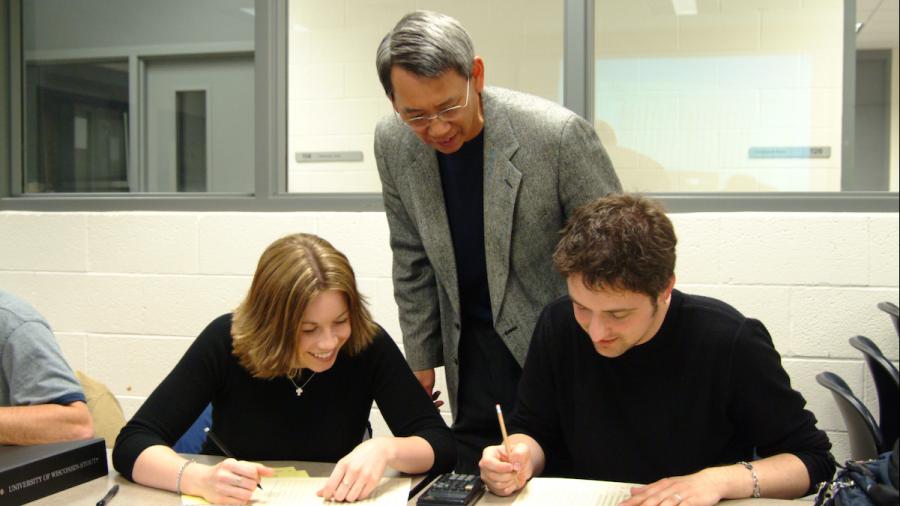
The Lees built a home in Marine on St. Croix and had three sons. In 1978, the family moved to Flagstaff, Arizona, where Lee took an assistant professor job at Northern Arizona University. He taught auto mechanics, drafting and supervised student teachers. “Teaching and working with Hopi and Navajo students and staff, I developed an understanding of different native cultures,” Lee said.
After a year, the family returned to Minnesota, and Lee enrolled at the University of Minnesota to complete his Ph.D. and worked as a graduate assistant, supervising student teachers in metro technical colleges. Upon graduating, Lee then worked for a year in Disease Prevention and Health Promotion at U of M Medical School, researching, writing grants and developing curriculum. He had the pleasure of working with Dr. John Najarian, the famous surgeon, and Dr. Michael Osterholm, then director of the Minnesota Department of Health.
He then joined the professional staff at 916 Technical College in Minnesota as a curriculum developer and became district staff development coordinator, evaluating projects with the vice president of Northwestern Bell to determine the effectiveness of projects. “Working with every group of faculty and staff at 916 and addressing their individual needs was very gratifying,” Lee said.
As their boys grew, Lee became Webelos leader, cubmaster and scoutmaster, while Charlotte served as den mother. Because of his industrial education background, he led many building activities for the Scouts.
In 1986, Lee returned to UW-Stout as program director for the M.S. and Ed.S. in vocational and technical education and served as co-director for the Center for Vocational and Technical Education, working with his mentor, Orville Nelson, a prolific grant writer. Large projects early on included the Turkish Training project, where the university sent several faculty members to Turkey, and 24 technical college instructors came to learn about Stout’s successful methods of teaching and laboratory work; and the Russian Construction project, where 40 Russians came for four weeks to learn about construction methods.
Lee’s leadership expanded as he served as department chair and program director for the B.S. in vocational education and technology education; as associate dean and dean in the School of Industry and Technology and the College of Technology, Engineering and Management, and later as executive director of Stout Solutions.
He ultimately returned to the faculty as professor and program director of career and technical education. He was the faculty advisor for the International Relations Club, developing lifelong friendships to this day. The Lees hosted many international students and visiting faculty. He was also the research advisor to many M.S. and Ed.S. students.
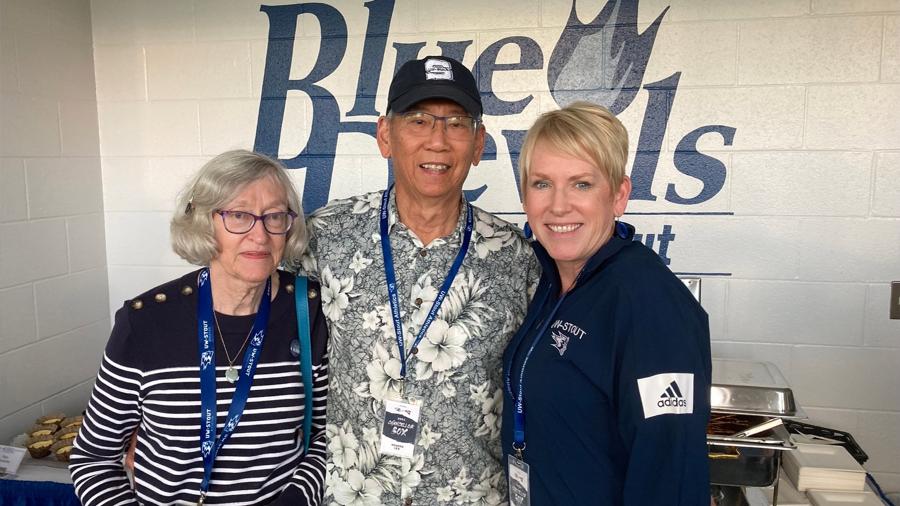
Lee was honored to be a Bush Fellow and did post-doctorate work at Carnegie Mellon University. He was a Dahlgren Professor and completed sabbatical research for a textbook, “Instructional Analysis and Course Development,” written with Nelson.
“I had the opportunity to work with so many wonderful people at Stout, including Orville Nelson, Bob Sedlak, Marty Ondrus, Bruce Siebold, Hans Timper, Diane Longsdorf, and Carol Mooney, to name a few. All of them have a legacy that influenced me,” Lee said. “It was very gratifying to watch students grow and follow them as they advanced throughout their careers.”
In 2006, the University of Minnesota’s College of Education recognized Lee as one of 100 graduates to receive the Centennial Award.
Upon retirement in 2009, Lee earned Emeritus status. He published five memoirs about growing up in Hawaii, his army experience, academic years, family life, jobs and retirement.
“Four things that contributed to my success at Stout and in retirement and my advice for students are to believe in yourself, build on past success, put forth effort and learn to ask for help. Success builds on success,” Lee said. “Develop a passion for what you believe in and develop competencies to reach your goals. I’ve used the basic problem-solving technique and covered it in class. Identify the problem, what are the possible solutions, consider implications to each solution, which is the most effective way to produce the desired results, what support is required, implement the solution and identify the metrics for success. This can be applied to everything you do in life.
“There is so much need for Stout students in the community. Find some service you are interested in, learn what is needed and develop a plan to get there. It’s a shame to have skills and knowledge and not use them,” he added.
It was important to Lee and Charlotte that they stay in the Menomonie community and share their education and training background in their retirement. His service to the Menomonie community reflects his exceptional achievement in philanthropy and civic engagement and demonstrates a commitment to education, dignity and community well-being.
Lee became a Master Gardener and helped establish the Dunn County Master Gardener Association. He was active with Pounding Fathers, building ramps, and worked on the first six Habitat for Humanity homes in Menomonie. He has served on the boards at Bridge to Hope, Stepping Stones, and Menomonie Senior Center, and continues to volunteer weekly at Meals on Wheels, Stepping Stones and St. Joe’s fish fry. He washes dishes after the monthly Menomonie Senior Center meals and served as a financial coach in the Dunn County Jail, helping those who needed assistance in managing their funds.
“My happy day is Monday, when I help kindergarten kids with reading. I’ve been doing this for the past four years, and I always come home happy and share my experience with Charlotte,” Lee said.
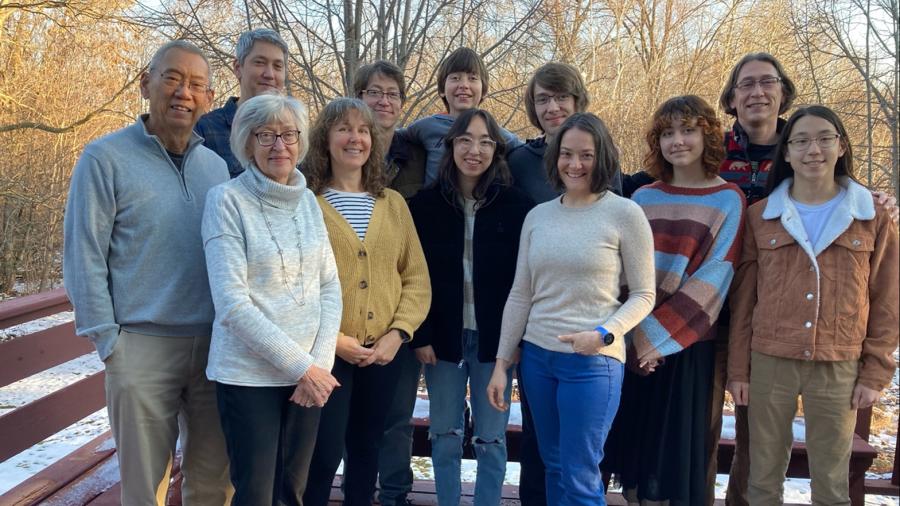
The Lees fund programs through the Community Foundation of Dunn County and other entities that contribute to UW-Stout Polytechnic and the Menomonie area. Their philanthropic commitment helps remove financial barriers and expand opportunities for students.
“Both Charlotte and I feel it is very important to provide scholarships to Stout students as we were both recipients of scholarships as students,” Lee said. “Assisting students and student teachers has been a priority for us. It is always a pleasure to meet Stout students who received our scholarships.”
The Lees attend many functions at UW-Stout Polytechnic, including athletics events. They host international students in the summer ESL program. As a program coordinator for Chippewa Valley Learning in Retirement, Lee develops programs to serve the senior community, including arranging tours of UW-Stout Polytechnic labs.
“We are a Stout family. Our three sons, Nathan (’97), Sheldon (’98), and Jonathan (’02), and daughter-in-law Ruth May (’00) are all alumni, and now Simon, a grandson, is at Stout in electrical engineering,” Lee said. “We have five grandchildren. I’ve always told my children that there are only three for sures in life: You are born, you live, and you die. You have no control of your birth and not much control of how you die, but you can have control of how you live. What you make of your life is entirely up to you, so live to the fullest, and be a contributing member of society. Throughout life and career, most of us need a great partner, and I am so fortunate to have Charlotte.”