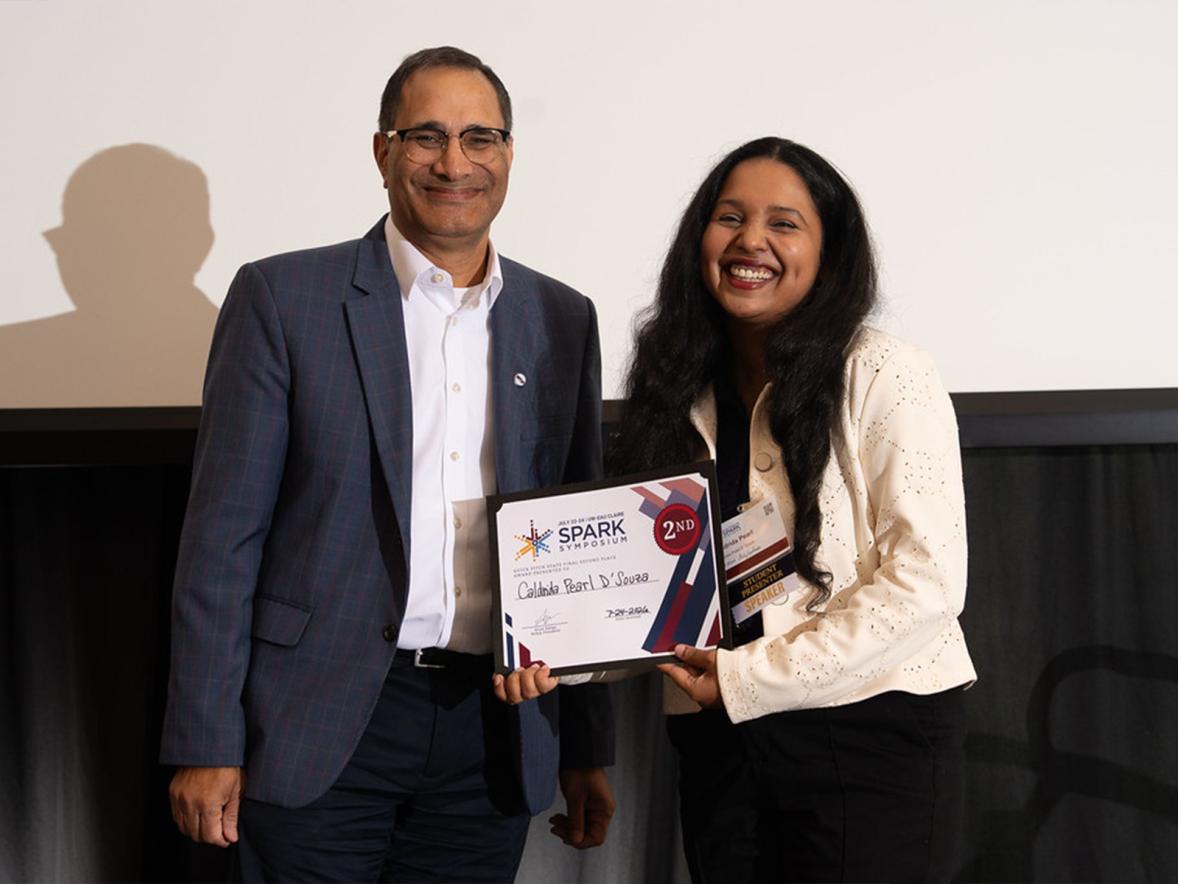






A stretchy, melty vegan cheese and new “swicy” sauce created by M.S. food science and technology students and recent graduates at UW-Stout Polytechnic had the audience saying, “Yum! Yes, please,” at this summer’s WiSys SPARK Symposium.
Caldrida Pearl D Souza earned second place during the WiSys Quick Pitch State Final for her “Comparative Analysis of Meltability and Stretchability in Traditional and Plant-Based Cheeses.”
People’s Choice Award at the Student Poster & Innovation Showcase was presented to D Souza, Nichitha Bhookya, Nikitha Bhookya, Premanvitha Salla and Sowmya Kotha for their research entitled “Development of Cherry-Tamarind ‘Swicy’ Hot Sauce.”
They were among the nine UW-Stout Polytechnic students who attended and presented five posters, joining 130 Universities of Wisconsin students at the three-day symposium, July 22-24.
Potato-soy protein blend vegan cheese, please
In her pitch, “Comparative Analysis of Meltability and Stretchability in Traditional and Plant-Based Cheeses,” D Souza discussed her master’s thesis of developing a vegan cheese formulation designed to improve protein content, meltability and stretchability compared with commercially available plant-based cheese alternatives.
“With most options of vegan cheeses in the market, a quick scan of their nutritional information labels shows that commercial vegan cheeses have a predominant carbohydrate and fat composition, often with minimal protein. I wanted to compare traditional dairy cheeses and commercially available vegan cheeses for their meltability and stretchability,” she said.
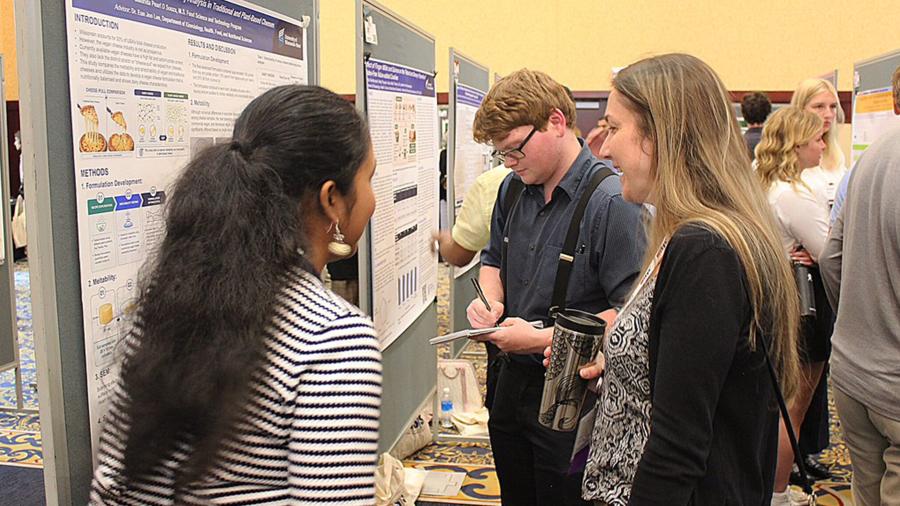
Based on her analysis, D Souza aimed to develop a vegan cheese recipe with higher protein and stretchability. She first used texture analyzer-based tests to compare textural properties, including stretchability, and evaluated the melting behavior of traditional and vegan cheeses to better understand the differences between the two. Additional analyses included scanning electron microscopy to examine microstructure, Fourier transform infrared (FTIR) analysis to investigate chemical characteristics, and texture profile analysis to measure properties such as hardness, chewiness and gumminess, she said.
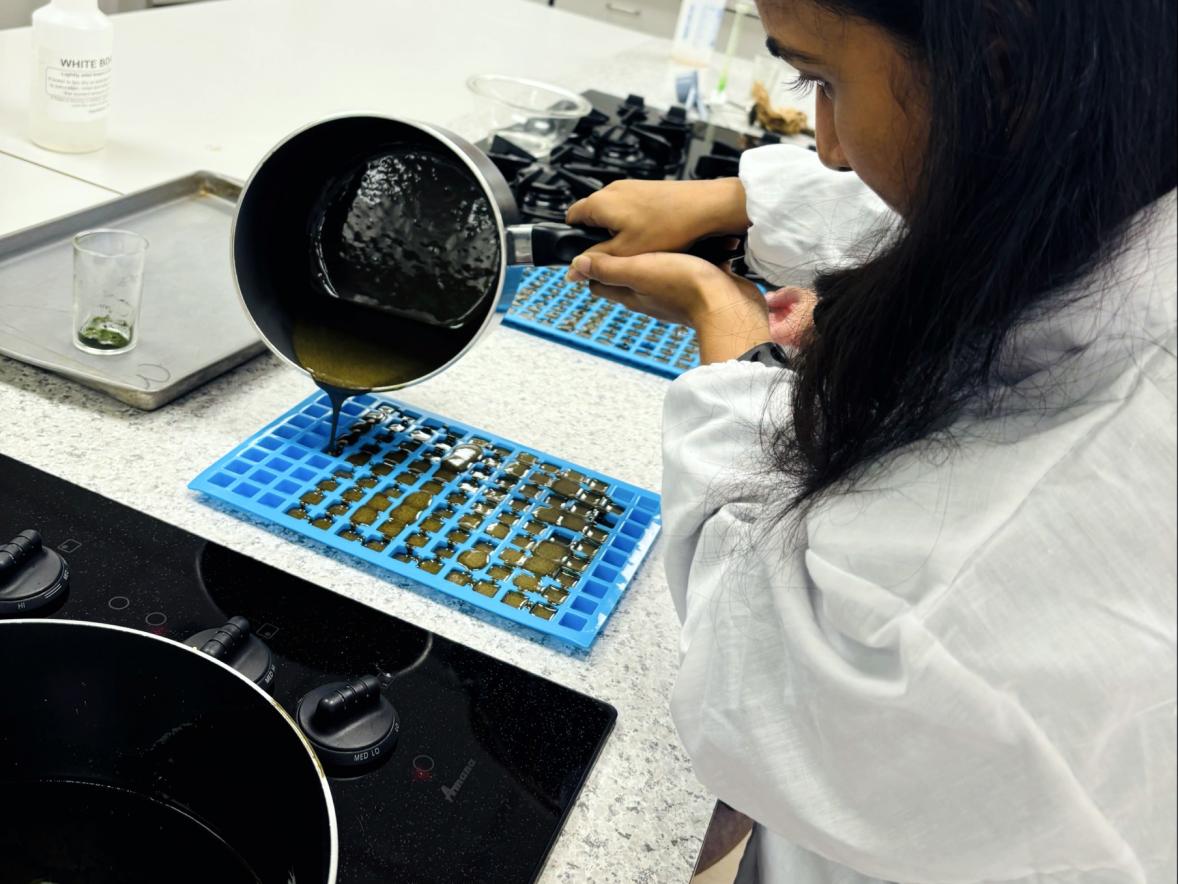
D Souza then developed ingredient formulations using plant-based protein, like soy, potato, and pea; a carbohydrate source, like tapioca and corn starch; and coconut oil as a fat source, to formulate a vegan cheese with improved protein content and stretchability and then analyzed its properties.
“My developed vegan cheese recipe is a potato-soy protein blend, in contrast to the predominant cashew or other nut-based vegan cheeses available on the market. I believe it offers some variation in core ingredients used, providing an alternative to nut-based vegan cheese formulations,” D Souza said.
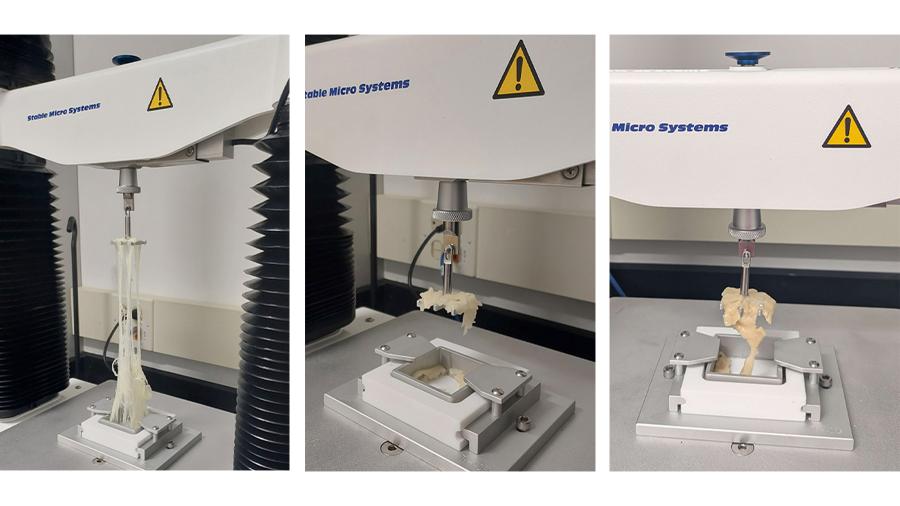
“The increased stretchability gives a more natural cheese-pull experience that you would get with dairy cheese,” she added. “The results showed greater stretchability than the commercial vegan cheeses tested, along with improved protein content.”
D Souza, who won first place at UW-Stout Polytechnic’s WiSys Quick Pitch event at the university’s Research Day in May, noted that her recipe is still in its initial stages of development, and further studies focusing on intermolecular bonds between starches, fats, and protein in these cheeses are needed to further optimize the formula.
A ‘swicy’ synergy for Gen Z wins People’s Choice
D Souza, Bhookya, Bhookya, Salla and Kotha researched the “Development of Cherry-Tamarind ‘Swicy’ Hot Sauce” as part of their Food Innovation and Plant Management course last spring.
The group researched market trends in food and beverages in 2026 and noticed the rise of the “swicy” trend in food products – a fusion of sweet and spicy flavors. They also noted that cherry had been identified as a major flavor trend for 2026.
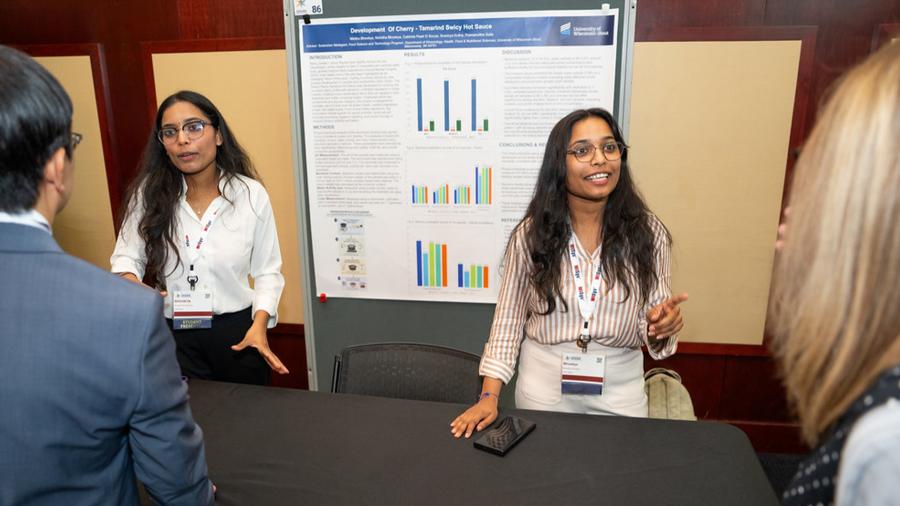
“Combining these aspects and adding a touch from our own roots (Indian flavors), we decided to make a cherry-based hot sauce that featured tamarind for a sour note and Indian red chili for the spice,” D Souza said.
Their innovation creates a synergy between tart, sweet fruit profiles and regional spices, and they anticipate that the cherry-tamarind hot sauce would perform better than store-bought sauces, specifically with Gen Z consumers.
“Market analysis shows that Gen Z likes spicy flavors and are open to try new and bold flavor combinations. Having Indian ingredients like the red chili and tamarind also adds a nostalgia factor, particularly for international Asian students in the U.S. who would love the taste of home,” D Souza added.
The group developed an acceptable recipe through trial and error, while also conducting characterization tests on physicochemical properties such as color, moisture content, water activity, and viscosity to ensure product stability and quality. They also performed a sensory analysis test on campus that involved 51 participants.
“The uniqueness of this product is that it is as spicy as it is sweet. Competitor cherry-based sauces or hot sauces currently available do not provide the flavor combination of sweet-sour-spicy that this product provides. There are Chinese- or Thai-based hot sauces, but an Indian-flavor-based hot sauce is pretty new,” D Souza said.
Connecting applied research to real-world needs
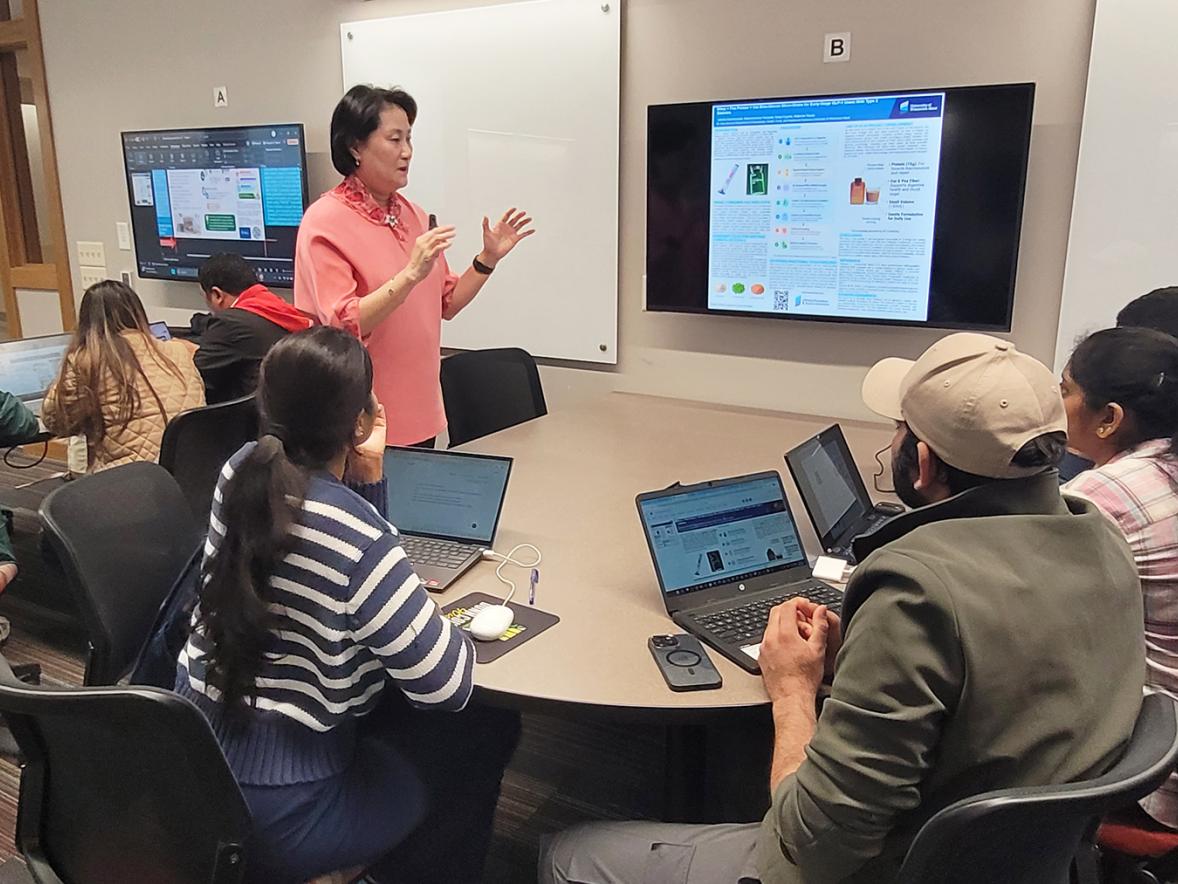
UW-Stout Polytechnic students extend classroom learning through applied research experiences, investigating meaningful questions in their fields and learning to communicate the significance and potential impact of their findings, said Professor Eun Joo Lee, program director of M.S. food science and technology and D Souza’s thesis advisor.
“When I prepare students for WiSys Quick Pitch, I encourage them to focus on why their research matters and to communicate a few key points clearly to a nonexpert audience. I also have them revise and repeatedly practice their presentation within the three-minute limit, using previous award-winning presentations as examples. Opportunities such as Quick Pitch are especially valuable because they give students a chance to communicate complex research clearly and connect their work to real-world needs,” Lee said.
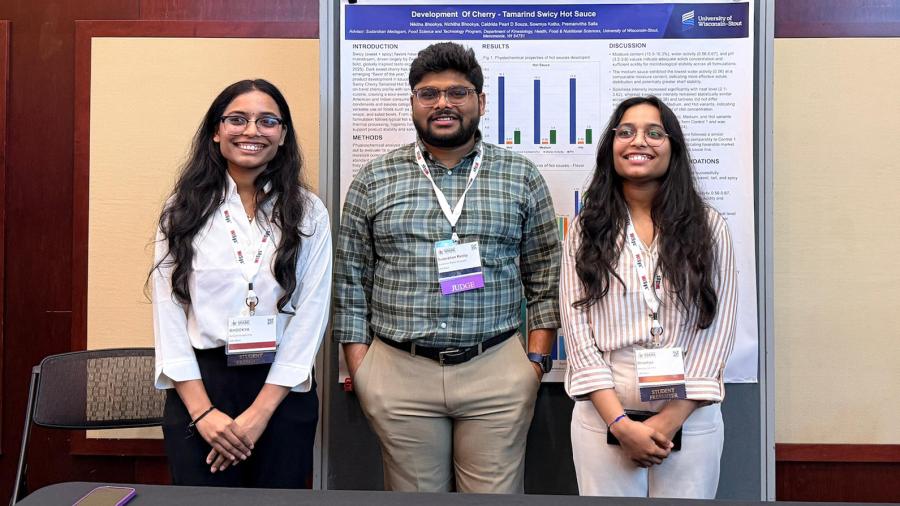
What began as a class project in their Food Innovation and Plant Management course evolved into an opportunity for D Souza, Bhookya, Bhookya, Salla and Kotha to develop, test, and present a novel product using the same types of processes they may encounter in industry, said Assistant Professor Sudarshan Medagam.
“Experiences like the WiSys Innovation Showcase help students build confidence, communication skills and a passion for innovation. Watching them earn recognition for their work and seeing their excitement throughout the process is incredibly rewarding and makes me very proud as an instructor,” Medagam said.
WiSys is a nonprofit organization that works with faculty, staff, students, and alumni of the Universities of Wisconsin to facilitate cutting-edge research programs, develop and commercialize discoveries, and foster a spirit of innovative and entrepreneurial thinking across the state.
The Quick Pitch challenges students to think beyond their research and explain the significance of their work to a general audience in a three-minute speech. The Innovation Showcase gives students the opportunity to present to attendees and a panel of faculty, staff and industry judges.
UW-Stout Polytechnic’s undergraduate and graduate food science and technology programs are offered through the kinesiology, health, food and nutritional sciences department. The department also offers a bachelor’s in health, wellness and fitness; as well as a bachelor’s in dietetics and a master’s in nutrition and dietetics.